PLATFORM REVIEW | Shenhai Hydrogen Energy No 1 – Chinese semi-submersible structure built for offshore wind-to-hydrogen trials
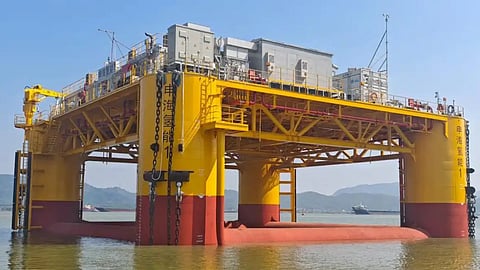
The semi-submersible platform for offshore wind-to-hydrogen Shenhai Hydrogen Energy No 1 (申海氢能1号; Shenhai Qingneng No 1) left Xinhui in Jiangmen, Guangdong Province, under tow on Friday, November 13. It is bound for waters off Danzhou in Hainan, where it will be deployed and tested offshore.
Chinese energy group Shenergy leads the demonstration project, which is linked to its Hainan CZ2 offshore wind project. Builder CIMC Raffles said the unit is the world's first semi-submersible wind-to-hydrogen platform.
The platform combines water electrolysis, hydrogen storage, and methanol production.
Shenergy said the demonstration will verify the integrated conversion and use of offshore renewable electricity under floating operating conditions. It will focus on the stable operation and coordinated control of the complete equipment installation in complex sea conditions.
Built to withstand extreme offshore conditions
Shenergy identified wind and wave disturbance and platform motion as the main challenges in adapting hydrogen production, storage, and methanol production equipment to the offshore environment.
Shenhai Hydrogen Energy No 1 has a length and beam of 33.1 metres (109 feet) and a moulded depth of 13.5 metres (44.3 feet). It was designed for the adverse sea conditions and shallow operating depths of the South China Sea.
The structure is designed for sea conditions with a 50-year return period and can withstand Beaufort Force 12 winds. It is held in position by a shallow-water, multi-point disconnectable mooring system.
The mooring allows normal operations to continue in Beaufort Force 10 winds.
Configured for remote operation

The platform can run in grid-connected or off-grid mode. CIMC said this capability, combined with motion-suppression technology, is intended to keep the proton exchange membrane (PEM) electrolysers producing without interruption in complex sea conditions.
The PEM electrolysis equipment has a rating in the 1,000 Nm³/h class. Three types of hydrogen storage system are installed, allowing several systems to be tested for marine adaptability. Remote monitoring allows operation without personnel on board and assists with maintenance.
Electrolyser maker H-Rise announced a 1,000 Nm³/h PEM hydrogen production system designed for floating offshore use, with demonstration planned at the Hainan CZ2 wind farm in 2026.
The company claimed DC consumption below 4.3 kWh per cubic metre of hydrogen and a dynamic response of five seconds. It also said the system weighs one-sixth as much as a conventional alkaline system.
Capable of continuous hydrogen production even in adverse conditions
Zhejiang Rein Hydrogen Technologies (REIN) supplied two steel-lined, carbon-fibre hoop-wound tube-bundle containers and one diaphragm compressor for compressing, filling, storing and transporting hydrogen at sea. The equipment was developed for the salt spray, high humidity, and high temperatures of the South China Sea.
According to REIN, the containers offer higher hydrogen storage density compared to conventional steel cylinder bundle containers. They are also lighter and resistant to fatigue and impact. Their standardised, modular construction is intended to ease offshore installation and maintenance.
The compressor has a compact modular layout to suit the platform's limited deck space. REIN said it can accommodate wave-induced platform motion and respond to fluctuations in wind power output to maintain continuous compression and filling.
CIMC said the platform is the first project of its kind in China to secure both classification by the China Classification Society (CCS) and statutory maritime inspection.
Shenergy said it is also the first offshore hydrogen platform in the country to be inspected through the full process under the CCS Guidelines for Offshore Hydrogen Production Facilities, a nine-chapter document that took effect on October 1, 2025, and that covers both floating and fixed installations.
CIMC Raffles was principal contractor. Veolia Marine Environmental Industry (Guangdong) undertook part of the steel fabrication and final assembly at Xinhui.
CIMC Raffles launched the platform on October 13. Commissioning of the onshore process systems had been completed by that date. Tugs floated the platform off after it left the slipway.
CIMC has presented the project as a continuation of its Yantai offshore hydrogen-ammonia-methanol pilot. That pilot entered commissioning on March 27, 2025, about five kilometres (three miles) off Yantai.