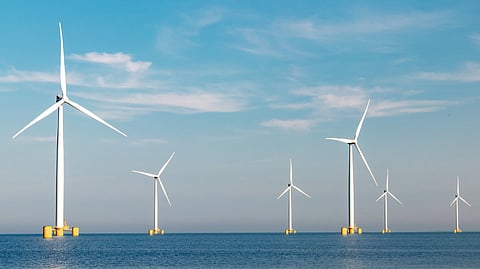


Poland allocated 3.4 gigawatts (GW) of capacity in its first competitive offshore wind auction, the country's energy regulator URE said on Thursday, a boost for the renewable energy sector after setbacks in neighbouring markets.
The auction was seen as a test of investor confidence in offshore wind, coming after US President Donald Trump's opposition to renewables effectively froze the US market and recent auctions in Denmark, Germany, and the Netherlands failed to draw bidders.
Poland awarded 25-year contracts at a price range of PLN476.88 ($133.09) and PLN492.32 per megawatt hour, URE said, just slightly below the maximum levels of PLN485.71–512.32 per megawatt hour set by the regulator.
State-controlled utility PGE secured a contract for 975 MW at PLN489 per megawatt hour, while refiner Orlen won a contract for 900 MW at a price of PLN476.88 per megawatt hour. A consortium of Polenergia and Norway's Equinor was also awarded a contract for 1.56 GW at a price of PLN492.32 per megawatt hour.
For Poland, offshore wind is vital for bridging a looming energy gap, with coal power being phased out, nuclear energy years away and its proximity to Russia heightening the country's emphasis on energy independence.
This comes despite rising costs in the offshore wind sector and its continued reliance on subsidies to remain economically viable.
Under the terms of the auction, support is offered to winners in the form of a contract-for-difference (CFD), which is essentially a taxpayer-funded subsidy.
The scheme ensures developers a guaranteed electricity price, with costs or savings (if any) passed onto consumers based on wholesale price fluctuations.
The overall amount of electricity covered by the contracts awarded at the auction is over 330 terawatt-hours (TWH), URE said, nearly double Poland's consumption last year. Poland plans to hold similar auctions every two years until 2031.
The projects that won the auction have a seven-year deadline to begin delivering electricity to the network, the regulator said.
(Reporting by Rafal Nowak and Marek Strzelecki; Editing by Susan Fenton and Matt Scuffham)
