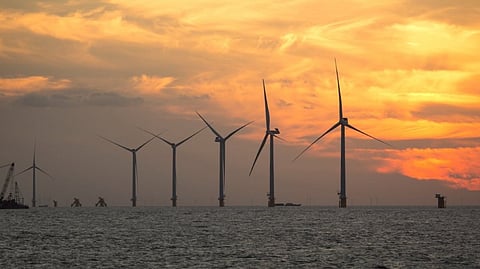


Italian plans to harness offshore wind energy are grinding to a halt, putting the country’s so-called climate goals at risk and hitting firms that have invested in the sector, analysts say.
A 2024 government decree offered incentives to spur 3.8 gigawatts (GW) of capacity by 2028, but the auctions for contracts have never been held amid bureaucratic and regulatory hurdles, stalling billions of euros in potential investments.
The decree approved in August last year targeted “innovative” renewables like floating wind platforms suited to Italy’s deep Mediterranean waters. Since then 26 projects have been presented for environmental approval, with a total capacity of 18 GW, according to Italy’s offshore energy lobby AERO.
An environment ministry panel has already approved four of these, but none can be launched without the promised competitive auctions, and industry frustration is mounting.
The head of AERO, which has obvious business interests, has warned that Italy is falling behind key European partners and hurting firms that have invested millions of euros to develop projects to present at auction. "The country cannot afford further delays," AERO chief Fulvio Mamone Capria wrote in a letter to the energy and environment minister made public last week.
Without the offshore wind sector, experts say Rome risks missing renewable energy targets approved by the government in July last year which aim for 28.1 GW of total wind capacity by 2030, up from a current 13 GW.
Italy’s conservative Prime Minister Giorgia Meloni is often criticised by environmental bodies for a lack of commitment to climate policies. She labels the European Union’s so-called Green Deal "ideological" and warns it will create "industrial desertification."
Aside from the environmental issue, Mamone Capria told Reuters the delays in the auctions are also jeopardising employment opportunities. Installing 3.8 GW of offshore wind capacity could generate more than 25,000 Italian jobs, according to AERO estimates.
As seen in other projects, however, this would come at the cost of substantial and expensive taxpayer subsidies in order to make offshore wind economically viable.
On paper, offshore wind offers “considerable potential” for Italy, a Mediterranean peninsula with limited land for solar or onshore turbines, yet the country lags far behind European peers. Britain boasts over 15 GW of offshore capacity, bolstered by mature auctions and subsidies. Germany follows with about 9 GW, driven by aggressive North Sea projects.
Italy, by contrast, operates just one small 30 megawatt farm. On the other hand, this also means it has so far avoided joining its peers in committing billions of euros in taxpayer subsidies just to prop up offshore wind projects.
(Reporting by Gavin Jones, editing by Susan Fenton)
