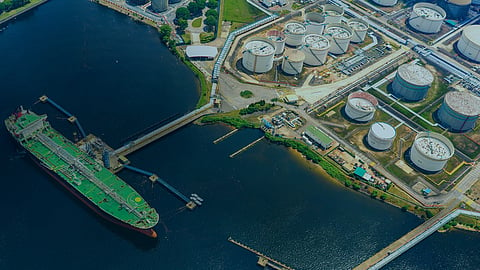


Asian refiners look set to be among the biggest beneficiaries of a sustained recovery in Middle Eastern crude oil exports.
Oil exports from the Middle East have largely returned to pre-war levels as tanker movements through the Strait of Hormuz have increased.
Total crude oil and condensate exports from the region — excluding Iran — averaged 18.11 million tons a week in September, according to Kpler, compared with a weekly average of around 18.22 million tons during the eight weeks prior to the start of the conflict with Iran at the end of February.
However, Middle Eastern fuel exports remain at less than half of pre-war levels due to damage to regional refineries.
That gap works in favour of those who can fill it. Asia holds around 37 per cent of global refining capacity, according to the Energy Institute, and refiners in India, China, South Korea and Singapore are well placed to capture the value attached to turning crude into gasoline, diesel and jet fuel.
The gains are not Asia's alone, as refining margins have climbed in all regions this year because fuel prices have risen more than crude oil costs.
Even so, the recovery in Middle Eastern oil supplies should mean that a larger share of the profits and pricing power attached to those barrels will flow to Asia's refining hubs for as long as the Persian Gulf's own refineries remain impaired.
Before the war, gulf producers spent years expanding downstream. Saudi Arabia, Kuwait and the United Arab Emirates invested heavily in refining and petrochemical capacity, seeking to capture more value from each barrel and reduce reliance on crude exports alone.
The conflict with Iran has disrupted that strategy. Roughly 20 refineries across the Middle East have been struck since fighting began, taking more than 2.3 million barrels per day (bpd) of refining capacity offline.
Damage assessments have been slow because of continuing tensions, but refineries are among the most complex industrial facilities in the energy sector and are much more difficult to repair than oil wells.
That situation means crude output and exports are likely to recover well before refining capacity does, leaving oil producers in the Middle East to rely on other refiners to process their crude.
Asian refineries have cut utilisation rates notably since the conflict began as crude supplies collapsed and shipping costs surged.
The Middle East supplied around 60 per cent of Asia's crude imports in 2025, according to Kpler, and the sudden drop in flows from the region prompted refiners across Asia to slash throughput by six million bpd in April, according to the International Energy Agency (IEA).
Refinery output has crept higher since, but there's room for further expansion. Many of Asia's large coastal complexes were built specifically to import crude in bulk and convert it into fuels and petrochemicals for domestic and export markets.
And the commercial incentives to crank up production are strong. Although refining margins in Asia have generally lagged those in Europe this year, profits from converting Middle Eastern crude into diesel and gasoline remain near record highs.
As more barrels become available, many refiners are likely to raise operating rates, boost exports and capture a larger share of global fuel production.
India appears particularly well positioned to benefit.
The country sits less than four days by sea from the gulf's major export terminals and is close to fuel-hungry markets across South and Southeast Asia that have faced supply disruptions since the conflict began.
India's refining capacity has expanded by roughly a third since 2010 to around 5.1 million bpd. The country is also home to the Jamnagar complex, the world's largest refinery, which exports diesel, jet fuel and gasoline to customers in Europe, Africa and Asia.
China also stands to gain. The country possesses the world's largest refining system, with capacity of around 18.8 million bpd, according to the Energy Institute.
While fuel export quotas often limit actual export volumes, access to more abundant Middle Eastern crude oil would improve refinery economics and strengthen incentives to maximise throughput.
South Korea and Singapore could benefit from higher utilisation rates and increased export activity. Both serve as major regional processing and trading hubs and are well positioned to handle larger flows of imported crude.
The consequences would extend far beyond Asia. A cargo of gulf crude refined in India could emerge as diesel for Europe, jet fuel for Southeast Asia or gasoline for Africa.
As more crude is routed through Asian processing hubs, those centres become increasingly important to global fuel security, pricing and trade flows.
The broader significance of recovering gulf production may ultimately be a shift in where influence is exercised across oil markets.
Since the outbreak of the conflict, much of the world's replacement crude supply has come from producers in the Americas, particularly the US. Those barrels have helped offset lost gulf exports and increased the strategic importance of Atlantic Basin suppliers.
Just over one-third of global crude oil and condensate exports came from the Americas during the second quarter of 2026, according to data from Kpler.
That figure compares with an average of roughly 22 per cent since 2024. The shift has given the US and other regional producers greater influence over trade flows, pricing dynamics and energy security discussions.
A sustained return of Middle Eastern crude would alter that balance. The US is itself a major refiner and fuel exporter, and so is not exposed in the same way as producers that rely primarily on crude sales.
Even so, the premium enjoyed this year by suppliers capable of replacing disrupted gulf exports is likely to diminish as Middle Eastern barrels return.
The market's bottleneck would also change. During the conflict, the key question was who could supply enough crude. As Middle East exports recover, the more important question is who can process that crude most efficiently and deliver fuels to end users.
In that environment, competitive advantage appears likely to shift to the large refining and export centres in Asia rather than to crude producers themselves.
A decade ago, gulf producers set out to capture more value from every barrel by expanding into refining and fuel exports.
The war has pushed them back down the value chain, at least for now. Until they rebuild what was damaged, much of the value in gulf crude is likely to be captured further east.
(Reporting by Gavin Maguire; Editing by Paul Simao)
