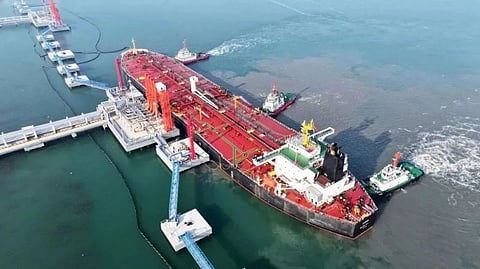


China's dramatic slashing of its crude oil imports has been credited with keeping prices from spiking during the Iran conflict.
The new question is whether the world's biggest oil importer can do the same for increasingly stressed refined products markets.
China's seaborne imports of crude oil dropped to the lowest in more than a decade in June, with commodity analysts Kpler tracking arrivals of 5.96 million barrels per day.
This was down from an average of 10.66 million bpd in the three months leading up to the US and Israeli attack on Iran on February 28, which started a conflict that resulted in the effective closure of the Strait of Hormuz.
A 60-day ceasefire between the United States and Iran that came into effect in June raised hopes that the narrow waterway through which about 20 per cent of global crude and refined products moved prior to the conflict would reopen.
But the ceasefire ended last week with the United States and Iran striking each other, and Tehran also attacking ships moving through the strait without its clearance.
While tanker movements through the strait are likely to fall dramatically with the renewed conflict, enough crude transited during the brief ceasefire to ensure that Asia's refiners are likely well supplied until at least the end of September.
Where pressure remains is in refined products, with global markets tightening as Russia bans exports of diesel after several of its refineries were damaged by Ukrainian drone attacks.
Russia is the world's second-largest exporter of the transport and industrial fuel and the ban comes just as peak demand in the northern hemisphere arrives from agriculture and construction.
The loss of Russian cargoes exacerbates the refined product situation in Asia, where volumes are still struggling with lower shipments from the Middle East.
Asia's imports of both light and middle distillates dropped to 5.19 million bpd in June, the lowest in Kpler records going back to 2017 and down 32 per cent from the 6.85 million bpd average for the three months leading up to the Iran conflict.
Part of the decline was because China placed an informal ban on exports of several refined products after the Iran war started in what was seen as a move to ensure domestic supplies.
China's exports of light and middle distillates dropped to the lowest in nearly five years in April, with Kpler tracking shipments of 350,000 bpd.
A small recovery saw this rise to 411,000 bpd in May and 423,000 bpd in June, but this was still well below the average of 719,000 bpd in the three months prior to the Iran war.
China is expected to export more refined products in July after Beijing relaxed its unofficial curbs and authorised at least one private refiner to resume shipments alongside state-controlled refiners.
Exports of diesel, jet fuel and gasoline could rise to three million tonnes in July, equivalent to just under 800,000 bpd, according to trade sources in China.
So far Kpler is estimating China's refined product exports at 585,000 bpd for July, but this figure is likely to rise as more cargoes are assessed.
The question for the market is whether this is enough to ease supply pressures. The answer is while it is certainly a help, it's likely that Asia's imports of refined products will remain at levels below what was normal prior to the Iran conflict.
This can be seen in prices for refined products, which remain well above where they were before the war and at higher-than-usual premiums to crude oil.
Singapore gasoil, the building block for diesel, last traded at $137.72 a barrel, and has climbed steadily since dropping to $109.35 on June 23 amid the initial relief at the ceasefire deal.
Gasoil is also 51 per cent higher than the $91.42 a barrel from February 27, the day before the conflict started, while global crude oil benchmark Brent futures ended at $83.30 on Monday, a premium of 14.9 per cent from February 27.
With renewed threats to crude and product shipments from the Middle East and depleted inventories across the world, it's likely that refined product prices will continue to push higher, even if the crude futures market keeps pricing for a resolution to the Iran war.
A further point is that higher prices for refined fuels may encourage China to keep exporting to allow its refiners to capture strong margins.
This may be the case even if crude imports don't recover to pre-war levels, as Beijing may take the view they can dip into their vast stockpiles in the expectation oil will be much cheaper when the conflict in the Middle East is resolved to the point of allowing vessels to move freely.
(By Clyde Russell, Editing by Sonali Paul)
