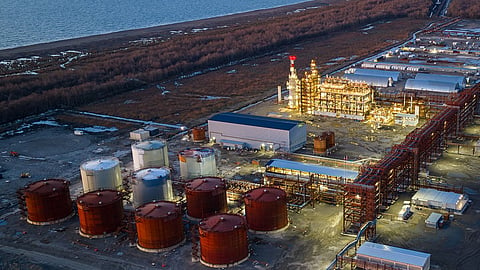


The EU has imposed sanctions on Georgia's Kulevi oil refinery for processing Russian crude, marking the first action against a major Georgian company as Brussels broadens efforts to target entities outside Russia that help sustain its oil revenue.
The European Union levied a transaction ban on Kulevi on Thursday in its 21st package of sanctions against Russia over its war in Ukraine. The ban will take effect in six months.
Located in western Georgia on the Black Sea coast, Kulevi came under scrutiny last October when Reuters reported that Russian company Russneft began shipping crude to the refinery.
Black Sea Petroleum (BSP), which owns and operates the refinery, did not immediately respond to a request for comment on the sanctions listing.
The Georgian foreign ministry said it was concerned by Kulevi's inclusion on the sanctions list and was taking all measures to ensure Georgia was not being used to circumvent sanctions.
"Georgia remains ready to cooperate with the European Union institutions and share all necessary information with them," the ministry was cited as saying by the Interpress news agency.
BSP said earlier this month that it would stop refining Russian crude from August-September, and instead source crude from Turkmenistan and Kazakhstan.
A senior EU official said discussions with Kulevi were ongoing and the refinery had committed to diversifying away from Russian crude.
"We'll give them some credit, but we want to see...that they do what they promised, and then we can propose to the council to delist them," the official told reporters in Brussels.
Georgia and Russia have had no formal diplomatic ties since their brief 2008 war, but Tbilisi has drawn closer to Moscow under the ruling Georgian Dream party, government critics say, and has boosted its own imports of Russian oil.
Kulevi started operations in October 2025 with an initial processing capacity of 1.2 million tonnes (mmt) a year. It processed more than 650,000 tonnes in the first half of this year.
Research by the Centre for Research on Energy and Clean Air (CREA) think-tank showed Kulevi received six shipments of Russian crude oil between last October and May 2026. During that period, Spain and Bulgaria received shipments from Kulevi.
CREA's research showed the EU and the United States received 1.46 million tonnes of oil products worth €811 million ($922 million) from the Kulevi port between February 2023 and February 2026.
(Reporting by Lucy Papachristou in Tbilisi; Additional reporting by Julia Payne in Brussels; Editing by Emelia Sithole-Matarise)
