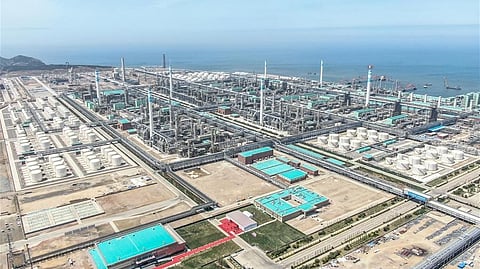


China is expected to tap deeper into its record crude oil inventories as refiners cut imports further while maintaining output curbs to minimise refining losses amid weak fuel demand, analysts and industry officials said.
Tepid demand from the world's top crude importer is partly capping global oil prices, which have fallen 19 per cent in May even amid a strained ceasefire between the US and Iran and with the Strait of Hormuz - through which a fifth of global oil supply usually passes - still largely closed for a third month.
Beijing has implemented a range of measures to insulate the country from soaring Middle East crude prices, including maximising domestic oil drilling, curbing fuel exports and providing extra import quotas to encourage purchases of discounted Russian and Iranian oil.
May seaborne crude imports could fall to the lowest in a decade at 6.451 million barrels per day, from 8.1 million bpd in April, according to Kpler. Another ship-tracking firm, Vortexa, estimated May imports at seven million to 7.5 million bpd. This comes after China's overall crude imports in April slumped 20 per cent on-year to 9.3 million bpd.
To compensate for the lower imports, refiners have in the past three weeks drawn on commercial inventories at a rate of around one million bpd, tapping into a stockpile that last peaked around 1.25 billion barrels in early May, according to Vortexa and Kpler.
Ye Lin, a senior analyst with consultancy Rystad Energy, said, "China is allowing inventories to draw down gradually rather than bidding aggressively into a tight market - a choice that makes sense given how deeply negative margins have become."
Vortexa's lead China analyst, Emma Li, expects state-run refiners to accelerate stock draws as imports decline further.
Commercial stockpiles expanded by some 70 million barrels during the first four months of this year, a result of hefty purchases of Russian and Iranian oil by independent refiners and traders, and as larger refineries slashed output from March, according to Li.
Even if the drawdown rates quicken to two million bpd, the more than 200 million barrels built up since early 2025 are enough to last through mid-September, Li added.
With oil hovering not far from $100 a barrel, Chinese refiners can afford to take a break from stockpiling in the near term thanks to large stock build before the war, traders said.
Chinese refiners face losses of CNY600 to CNY1,300 ($88.74 to $192.26) for each tonne of crude processed depending on grade as Beijing capped domestic pump prices to shield consumers from global price spikes, analysts said.
Large state-owned refineries led by Sinopec, the world's largest refiner by capacity, and biggest independent processor Zhejiang Petrochemical are set to maintain throughput curbs at least in June, trading and industry sources said.
Smaller plants known as teapots are under mounting pressure to trim runs in June and beyond despite a government order not to, according to teapot officials and analysts.
Several Shandong-based teapots are prepared to reduce or suspend processing after running down the crude stocks built in March and April, said an official briefed by plants during a recent visit to the refining hub.
Reflecting lacklustre demand, commercial gasoline and diesel inventories sampled and tracked by Chinese consultancy Oilchem stood at the highest since early 2024 and July 2024, respectively.
Gasoline demand destruction by electrification has become deeper than thought as higher petrol prices forced more lasting change in behaviour by prompting people to use more public transport, analysts said.
Michal Meidan, research head at Oxford Institute for Energy Studies, said China can sustain a five per cent run cut versus the five-year average, which would require seaborne crude imports of 7.9 million bpd, a level in line with estimated imports for May.
"While there would be some mismatch between products and chemicals, and refining margins would suffer, basic supplies would still be guaranteed before stakeholders would need to massively draw stocks or return to the market," Meidan wrote in a report last month.
(Reporting by Chen Aizhu and Sam Li; additional reporting by Siyi Liu; Editing by Florence Tan and Kevin Buckland)
