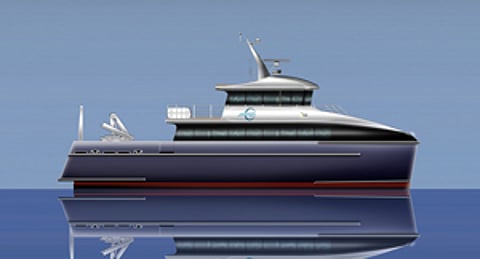

Incat Crowther has announced the design of a 24-metre catamaran scientific research vessel. The vessel will mark the start of a new relationship between Incat Crowther and growing Estonian boat builder Baltic Workboats.
The vessel will be operated by Lithuania's Ministry of Environment in the near-shore areas of the Baltic Sea.
Developed to meet comprehensive design guidelines, the vessel is a practical, efficient and rugged vessel, claims the company
The aft deck features lower platform access, hydraulic A-Frame, 5.7tm Guerra deck crane and moon pool. The main deck cabin will feature two workspaces. To port will be a hydrological lab, with three workstations and bathroom. To starboard will be a chemical-biological laboratory with sinks, four workstations and eight-square-metre storage room. At the forward end of the cabin is a crew mess and galley, as well as laundry facilities.
The upper deck wheelhouse has excellent all round visibility with direct access to the foredeck.
To address the vessel's diverse operation, oversized wireway paths have been provided. This allows for easy installation and reconfiguration of seismic survey and data acquisition equipment.
The hulls accommodate 11 crewmembers in five twin cabins and a single cabin for the captain. Each hull has a shower and toilet room.
A pair of Volvo Penta D9 main engines, each producing 425kW at 2,200rpm will power the vessel. The vessel will drive through a pair of ZF 325-1 reversing reduction gears to 5-bladed fixed-pitch propellers. It will have a service speed of 12 knots, with a top speed of 14 knots.
At a cruising speed of 10 knots, the vessel will provide and economical fuel consumption of just 3.75 l/nm, providing a range of over 1,000nm.
