

Energy exploration has picked up sharply in Australia driven by growing Asian gas demand, technological advances and an improved investment climate, with the Iran war underscoring the urgency to develop supply, after years of sluggish spending.
Quarterly oil and gas exploration spending in Australia, the world's No. two liquefied natural gas producer, hit a 10-year high of AU$471 million ($329 million) in the March quarter, government data released in June shows.
Energy investment sentiment has improved in part following last year's election of a more supportive second-term Labor government, which faces pressure to fill a looming end-of-decade domestic gas shortfall without harming valuable LNG exports.
Spending is expected to increase about 10 per cent in 2026 to more than $1 billion, according to Rystad Energy, although Canberra's move last month requiring that 20 per cent of gas be set aside for domestic use has sparked industry backlash.
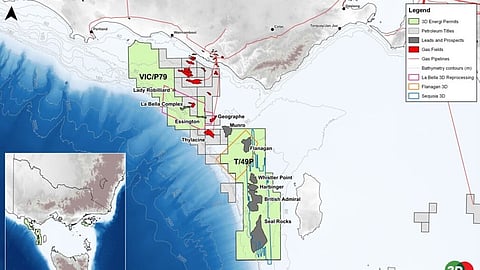
Much of the drilling is focused on three gas-rich regions: the Otway Basin offshore western Victoria, the Beetaloo shale in the Northern Territory, and the Taroom Trough in Queensland. Among them, the Otway is the most established and is close to existing infrastructure.
While the search for more gas and oil in recent years has been concentrated onshore, costlier and riskier offshore investment is on the rise.
"We’re seeing renewed interest in frontier and unconventional plays as modern techniques de-risk development," said Krishan Pal Birda, vice president at Rystad Energy.
In the Otway, exploration has jumped, with companies sharing rigs to cut costs, but their campaigns have had mixed results.
"There is a lot more activity in the Otway than we've seen in years," Amplitude Energy CEO Jane Norman told Reuters. US major ConocoPhillips drilled two wells in late 2025, the country's first offshore wildcat wells in several years, with one well yielding gas, while a second found gas but not at the level predicted and with a much higher carbon dioxide content than expected.
Some industry watchers have suggested that if ConocoPhillips can develop a steady supply of gas to the tight east coast market, that could defray obligations to supply the market from its export project, Australia Pacific LNG.
"Further work is now underway to progress an offshore project proposal for a potential offshore development to bring more supply to the domestic market," a Conoco spokesperson said in an e-mailed statement.
Amplitude drilled a well that was deemed "non-commercial" in March and is reviewing whether to proceed with a follow-up well.
Wilkinson said offshore exploration, such as in the Otway, was promising but remained expensive.
“We think it's a proven petroleum basin — it's got great rocks. The only issue is that CO2 sometimes shows up,” he said.
The government's plan to require LNG exporters to hold 20 per cent of their gas for the Australian market may deter smaller players from investing more in exploration, because the increased supply could keep a lid on domestic gas prices.
Canberra has yet to spell out how the gas reservation will work. "Capital wants to find happy, comfortable places to invest, and at the moment the confusion is making it very hard to invest," Brett Woods, CEO of the country's number three oil and gas firm Beach Energy, told Reuters.
(Reporting by Helen Clark; Editing by Tony Munroe and Sonali Paul)
