
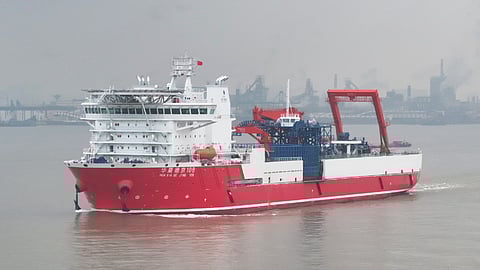
VESSEL REVIEW | Huaxia Dejing 108 – China's largest cable laying vessel enters service
Jiangsu Dayang Offshore Equipment has completed construction of what it said is the largest cable laying vessel (CLV) ever built in China, as well as the largest single-carousel CLV in the world.
Huaxia Dejing 108 (华夏德京108) is owned by Huaxia Financial Leasing and operated by offshore construction company the Dejing Group.
The newbuild has an LOA of 171 metres (561 feet), a beam of 38 metres (120 feet), a depth of 12.8 metres (42 feet), a displacement of 35,000 tons at full load, a service speed of 13 knots, and submarine cable and fibre-optic capacities of 15,000 tons and 3,000 tons, respectively.
Increased capacity for fewer voyages

The capacities allow Huaxia Dejing 108 to transport and install larger and heavier submarine and fibre-optic cables in a single voyage and to simultaneously lay two separate cables, thus enabling projects to be completed in less time.
The onboard equipment can lay submarine cables at a depth of 300 metres (980 feet) while fibre-optic cables can be installed at 500 metres (1,600 feet).
Notable features include an intelligent operating system, an A-frame with a lifting capacity of 80 tons, a burial plough that can be deployed at a depth of 500 metres, a remotely operated vehicle for cable burial and emergency repair, a helicopter deck to facilitate crew transfers, and a DP2 system capable of accurate station keeping even under extreme offshore conditions.
The DP2 system will enable cable installation to be carried out within a broader weather safety window, thus allowing for a greater number of projects to be completed each year.
Fitted out for domestic and global deployment
Power for the onboard systems is supplied by six generators. The propulsion system also includes three 3MW main azimuthing thrusters, two 2.8MW side thrusters, and a 2.5MW retractable thruster.
Huaxia Dejing 108 was built in compliance with China Classification Society requirements. The CLV can be deployed on both domestic and overseas cable installation projects.
In addition to laying cables connected to offshore wind farms as well as umbilical cables at oil fields, the vessel can also install cables through which electricity can be supplied from the mainland to remote island communities.
