
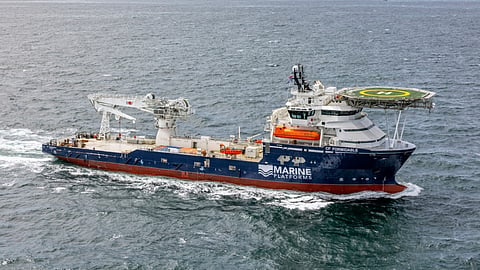
VESSEL REVIEW | CF Formidable – Hybrid multi-role OSV boasts long endurance and redundant features
The Holland Shipyards Group has handed over a new offshore construction support vessel (OSCV) to Chevalier Floatels (CF).
The 110-metre (360-foot) long CF Formidable is a DP2-capable subsea vessel that will be used for offshore construction, walk-to-work duties, remotely operated vehicle (ROV) support, well intervention, inspection, maintenance, surveys, dive support, cable repair, and trenching. For her initial charter, the vessel will be operated in Nigeria in support of Chevron with Tschudi responsible for ship management.
The OSCV's hull was built in Spain and utilises a Marin Teknikk design. CF purchased the hull from the vessel's previous owners and had it towed to the Netherlands for completion at Holland Shipyards' Hardinxveld facilities. Vera Navis Ship Design of Portugal provided production engineering support for the project.
Originally built for a specialised role

CF Formidable was originally planned to be completed as a drilling unit with Modu Code certification, but was changed to a vessel with SPS notation.
“She has a very high accommodation standard and a very high redundancy level thanks to her five diesel-electric generators,” CF told Baird Maritime. “She is one of the first to reach the market in this new wave of subsea vessels that are being built, and her design has a very well proven track record in the subsea industry.
“Although the hull was laid many years ago, we have outfitted her to the latest standards and with the latest equipment so that she would effectively become a new vessel. Completing an existing hull compared to laying down a new hull reduced carbon emissions in the building process considerably.”
The owner said that, because the vessel was a proven subsea platform with a long operational history and multiple examples built on the design, this reduced technical and operational risk. She also delivers enhanced seakeeping with a relatively wide 22-metre (72-foot) beam and a hull form optimised for offshore operations, providing a stable working platform for ROV and subsea activities.
The vessel has exclusive furnishings for 120 POB as well as office, meeting, and operating room facilities for clients, with the interior outfitting provided by Hoogendoorn 1961. CF said the vessel is prepared for conversion to house over 200 POB if needed, thanks to an SPS-certified accommodation block developed in-house by the company.
The OCSV was built with IMO Tier III purification equipment and is equipped with a battery for energy storage for energy peak shaving and spinning reserves.
“While the rest of our fleet operates on the spot market, yielding strong results but introducing volatility, we sought a vessel that could stabilise our income and offset these market risks,” CF said. “Consequently, we invested in a larger, high-specification subsea vessel engineered for maximum versatility. CF Formidable perfectly meets this need, being capable of supporting both renewable and traditional oil and gas projects across the construction and maintenance phases.”
Outfitted for low-emission operations
CF added that the vessel will be replacing older tonnage, as there have been very few newbuilds delivered for many years.
“Using the latest technology, she will have a lower environmental footprint,” the owner told Baird Maritime. “Also, the high accommodation standard will improve the living conditions offshore for both oil majors personnel and local personnel. Lastly, the crane will lead to greater precision and efficiency in offshore operations.”
CF Formidable’s propulsion arrangement includes a Kongsberg package consisting of two TT2400 tunnel thrusters forward, one UL1411 retractable azimuthing thruster, and two AZP120 main azimuthing thrusters aft that help propel the vessel to speeds of over 16 knots. These thrusters all utilise fixed-pitch propellers.
“This five-thruster arrangement provides exceptional manoeuvrability, strong station-keeping performance, and a high level of redundancy for offshore operations,” said CF. “The combination of fixed tunnel thrusters, a retractable azimuthing thruster, and twin azimuthing main propulsors offers excellent thrust distribution across the vessel envelope, allowing efficient DP operations in challenging environmental conditions. The retractable azimuth thruster further enhances low-speed manoeuvrability and DP capability while providing additional redundancy for critical offshore activities.
“Overall, the propulsion system combines proven technology with modern DP control integration, delivering a robust, flexible, and highly efficient propulsion solution for subsea, offshore construction, renewable energy, and ROV support operations.”
Full backup systems available on board
Many offshore vessels are arranged as two redundancy groups, namely, port and starboard. In the case of CF Formidable, there are a port, a centre and a starboard group. Each group has its own power source and thruster allocation, and the owner said this provides a higher degree of fault tolerance compared to a conventional two-group arrangement.
“The centre switchboard powers a single retractable azimuthing thruster that forms its own independent redundancy group. This is noteworthy because the vessel can still retain significant propulsion capability after loss of either the port or starboard group.
“The retractable azimuthing thruster provides both transverse and longitudinal thrust, unlike a tunnel thruster that primarily provides lateral force. For DP operations, this is a very effective arrangement.”
The electronics suite includes a Kongsberg DP-21 DP2 system and a redundant power management system. All critical sensors, networks, controllers, and power supplies are duplicated and segregated. The vessel can tolerate the loss of a complete electrical/control group and still maintain position within its DP2 design intent.
“The chosen DP sensor package includes multiple independent references: GNSS receivers (primary satellite positioning); a HIPAP acoustic positioning system; a SpotTrack laser positioning system; wind sensors; and gyrocompasses and motion sensors. This provides the diversity required for offshore DP operations and allows the DP system to continue operating if one reference type fails.”
Full deck equipment suite and helicopter capability
The vessel offers a highly capable and adaptable offshore working platform, featuring 1,200 square metres (13,000 square feet) of clear deck space with a uniform deck loading capacity of 10 tonnes per square metre, making it ideal for the transportation and deployment of heavy project cargo, subsea equipment, containers, and offshore construction spreads.
“The vessel is equipped with a NOV 150-tonne knuckle-boom offshore crane, providing substantial lifting capability combined with excellent reach and operational flexibility for subsea and offshore installation activities,” CF told Baird Maritime. “In addition, two five-tonne stores cranes facilitate efficient handling of provisions, spare parts, tools, and project equipment, allowing routine logistics operations to be carried out without impacting main deck activities."
The owner remarked that another notable advantage is the vessel's removable bulwark system, which will enable unobstructed loading and discharge of oversized cargo, improve access for project mobilisations, and enhance flexibility for a wide range of offshore construction, ROV, renewable energy, and accommodation support operations.
“Together, the spacious high-strength deck, heavy-lift crane capacity, and configurable deck layout make CF Formidable a versatile and efficient platform capable of supporting complex offshore projects in demanding environments.”
The vessel boasts a 7.2- by 7.2-metre (24- by 24-foot) moonpool, providing a protected launch and recovery environment for ROVs, survey equipment, subsea tooling, and other over-the-side deployment systems. The latter feature will enable safe and efficient subsea operations under a broader range of weather conditions while minimising exposure to wave action and improving operational uptime.
The vessel is equipped with a fully certified bow-mounted flight deck designed and approved for international offshore helicopter operations. The helideck has a D-value of 20.9 metres (68.6 feet) and a T-value of 12.6 tonnes, complies with ICAO Annex 14 Volume II and UK CAA CAP 437 requirements, and is certified for day and night helicopter operations.
The installation also includes modern LED lighting, a helideck monitoring system, meteorological monitoring equipment, firefighting and rescue systems, and dedicated helicopter operations facilities. Paint for the helideck was provided by PS Marine Coatings.
“An independent inspection concluded that the helideck is well equipped and suitable for safe international helicopter operations,” said CF.
Previous experience providing an advantage in overcoming construction challenges
The owner explained that adapting an existing hull to enable it to perform multiple functions presented some challenges.
“The first challenge was in purchasing the vessel. The previous owners had made quite some decisions regarding the hull, and straightening all these out legally so that the vessel could be released to us was a challenge in itself.
“The next challenge was reclassing the vessel to SPS without compromising the capabilities of the vessel. Then the entire vessel would have to be built in compliance with all the latest newbuild regulations.”
Fortunately for CF, the company had already completed a number of conversions of existing vessels.
“In the past we had repurposed several vessels to new roles, so there was a good understanding within the team of what was required,” the owner told Baird Maritime. “We build the ship on an open book basis with the shipyard. Because of this, both the yard and the build team worked as one unit and could therefore exchange ideas about optimisations in the construction process, and without commercial issues hindering those discussions.”
