Cadeler has published its interim financial results for the first half of 2026 reporting strong financial performance, with both revenue and gross operating profit more than doubling compared to the first half of 2025 (when adjusting for one-off termination fees in the comparative period).
Cadeler said the results demonstrate that its fleet strategy is delivering as intended, positioning the company to support customers through the next phase of offshore wind development.
Revenue for the first six months of 2026 more than doubled to €408 million (US$476 million), an increase of €220 million (US$260 million) compared to revenue of €188 million (US$219 million) for the same period last year.
Gross operating profit for the first six months of 2026 also more than doubled to €208 million (US$243 million), an increase of €106 million (US$124 million) compared to gross operating profit of €102 million (US$119 million) for the same period last year (in each case, when adjusting for one-off termination fees of €111 million/US$130 million in the comparative period).
Profit for the period rose to €88 million (US$100 million), a year-on-year increase of €31 million (54 per cent) from profit of €57 million (US$67 million) in the comparative period, adjusted for the termination fees identified above.
The increase was mainly driven by fleet expansion and a higher number of contracted days. Fleet utilisation of Cadeler’s ten vessels remained stable at 66 per cent for the period, compared to 67 per cent in the same period last year.
Cadeler maintains its full-year 2026 guidance, with revenue expected to be in the range of €854 million to €944 million (US$997 million to US$1.1 billion), and gross operating profit to be within the range of €420 million to €510 million (US$490 million to US$600 million).
Cadeler’s acquisition of Menck on August 11, 2026, is expected to impact the consolidated Cadeler Group’s revenue and gross operating profit guidance for 2026. Cadeler is reviewing the extent of that impact and will provide an update in due course.
"These results demonstrate that our fleet strategy is delivering as intended, providing the flexibility, reliability and operational capabilities required to support the next phase of offshore wind development as customers place increasing emphasis on the resilience of their supply chains and certainty of delivery," said Mikkel Gleerup, CEO of Cadeler.
"As our fleet, project portfolio and organisation have continued to grow, Cadeler has remained focused on disciplined execution, adapting quickly to changing project requirements and supporting our customers across multiple installation projects in H1 2026."
For Cadeler, the defining theme of the first half of 2026 was execution. Cadeler said that it operated its fleet at a new scale, with ten vessels in active operation, and that it demonstrated the benefits of that scale through greater flexibility and redundancy to mitigate operational risks across multiple projects. When project requirements changed, Cadeler rapidly redeployed vessels, helping customers maintain project momentum and mitigate the risk of delays.
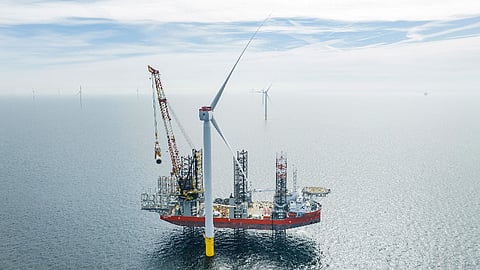
Cadeler said it also commenced its first full-scope monopile foundation transportation & installation (T&I) campaign at Ørsted’s Hornsea III offshore wind farm which, when complete, will be the world’s single largest offshore wind farm. The company said that, with this campaign, it is proving the capabilities it has invested in over recent years to support its ambition of becoming the leading provider of integrated foundation T&I solutions.

