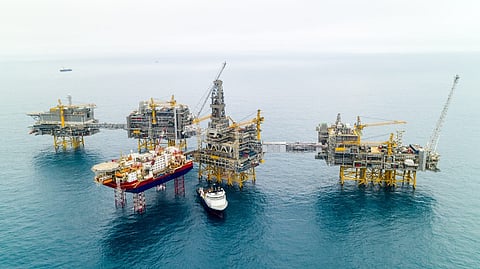


Norway's offshore oil and gas output will remain broadly steady in 2026, but investments are seen falling by 6.6 per cent, signalling a slowdown in activity and declining production towards the end of this decade, the country's regulator said on Thursday.
High investment in recent years was underpinned by large developments that are gradually coming to an end, while new projects are mostly smaller in size, the Norwegian Offshore Directorate (NOD) said.
"The (output) plateau is expected to last until 2027, and then the production will taper off," Torgeir Stordal, the head of the NOD, told Reuters.
This year, Norway's total oil and gas output is expected to hold steady near 4.1 million barrels of oil equivalent per day (boed), declining to just under 3.5 million boed in 2030, the regulator's updated forecasts showed.
Spending, including exploration, is projected at 256 billion Norwegian crowns ($25.5 billion) in 2026, down from 275 billion last year on a comparable inflation adjusted basis, and is seen falling to 209 billion in 2030, 24 per cent below last year's levels.
The shrinking project pipeline is already hitting suppliers, some of which have started downsizing.
"There will be less stand-alone developments, and much more subsea developments. It will impact the supply industry," Stordal said, highlighting a shift toward smaller subsea tie-backs rather than large greenfield projects.
Natural gas production is seen at 123.1 billion cubic metres (bcm) in 2026, equivalent to 2.1 million boed, up from 119.8 bcm last year but below the 2024 record of 124.2 bcm.
Stordal said gas output should stay high for three to four years, sustaining Norway's role as Europe's top supplier after Russia's invasion of Ukraine.
Production of oil, including condensate and natural gas liquids, is seen easing slightly to two million barrels per day (bpd) this year from 2.04 million bpd last year, which marked the highest level since 2009.
(Reporting by Nerijus Adomaitis and Nora Buli, editing by Terje Solsvik)
