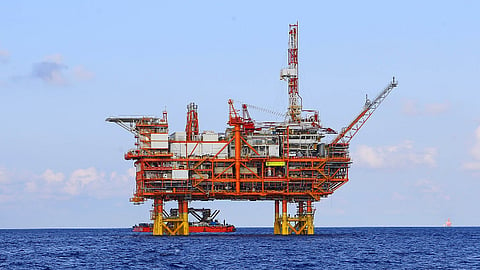


China, the world's top oil importer, succeeded in a seven-year campaign to boost its own production, achieving a record high last year with aggressive drilling at ageing fields, an offshore boom and nascent shale oil output.
But it is reaching what experts say is the limit of what it can economically produce, as offshore growth starts to taper off and higher-cost unconventional resources prove increasingly difficult to exploit, according to analysts.
Output is expected to plateau just below last year's record 4.32 million barrels per day (bpd) for another decade, industry experts say, a level seen in the industry as a national security stabiliser for basic manufacturing and military needs.
Beijing's 2026-2030 plan, released on March 5, confirmed that view, calling for output to be maintained at four million bpd.
That means China will remain heavily reliant on imports, which last year totalled 11.55 million bpd, even as its oil demand peaks with the country electrifying its transportation fleet and economic growth slowing.
The three national oil companies are trying to maintain that level as long as they can, which is seen as a minimum amount to cope with unpredictable supply disruptions, said Zhu Weilin, a professor at Shanghai's Tongji University who until 2016 was chief geologist at China National Offshore Oil Company (CNOOC).
Highlighting the need for domestic production, the escalating war in the Middle East has cut crude exports from the region that supplies half of China's imports.
China first hit the four million-bpd output mark in 2010 when its demand was exploding.
Its flagship Daqing oil field, which opened sixty-six years ago and was held up by Mao Zedong as a model of China's industrialisation, remains essential, yielding 600,000 bpd.
At the sprawling field in northeast China, engineers apply technology known as "tertiary recovery", injecting a mix of chemicals into oil reservoirs to "scrape the last grease off a plate", as Zhu described it.
According to CNPC experts, such methods boost output by 20 per cent above "secondary" recovery that involves injecting water.
"The scale of polymer flooding in Daqing oil field is unparalleled, and the method appears to have been highly optimised," said Oscar Abbink, upstream technology director at SP Global Energy.
The expertise of injecting chemicals as well as heat, and more recently carbon dioxide and gas, to wring out more oil from mature wells, honed over the past quarter-century and expanded to other ageing fields, such as Liaohe and Xinjiang, has won CNPC's drilling team contracts in countries including Saudi Arabia and Iraq.
Cheng Jiecheng, Daqing's chief expert on tertiary recovery, told CNPC's in-house newspaper last June that the chemical-based technology alone could unlock an additional 7.3 billion barrels of reserves from China's older fields.
Tertiary recovery has yielded some 161 million barrels of oil a year for CNPC alone for the past two decades, or 10 per cent of national output, and will likely grow to 219 million barrels by 2035, said a separate industry veteran specialising in the field, declining to be named as he was not authorised to speak with media.
While such technologies are also used in North America and the Middle East, China's use of them is at the largest commercial scale and among the most cost-efficient, said Yu Baihui of SP Global Energy, who estimated China's tertiary efforts are delivering 20 per cent of output.
Alarmed when production fell below four million bpd in 2016 after companies shut in high-cost wells in the face of crashing oil prices, Beijing in 2018 launched a seven-year action plan rallying state giants to accelerate drilling. That push included tapping tougher terrain as deep as 10,000 metres (6.21 miles) below the Gobi Desert and stepping up offshore production.
Offshore specialist CNOOC led production growth with projects such as Bozhong 19-6 and Bozhong 26-6 in northern China's Bohai Bay and the deepwater Kaipingnan field in the South China Sea.
Bohai, now China's most productive region, pumped 740,000 bpd of crude in 2025, 55 per cent more than a decade earlier. Bohai accounted for 40 per cent of national output growth between 2021 and 2025, CNOOC said.
Since 2010, state firms have boosted drilling in shale formations, using hydraulic fracturing, or fracking, and horizontal drilling techniques.
However, in China such oil is mostly found in lacustrine shale formed from freshwater lakes where hydrocarbon deposits are more fragmented than in the marine shale that has driven a production boom in North America, with record US shale oil output around 9.7 million bpd last year.
While lacustrine shale has never been commercially developed anywhere, Chinese companies pumped nearly 164,000 bpd of shale oil last year, up 30 per cent from 2024, from pilot projects at Qingcheng in the Ordos Basin, Gulong in Daqing and Jimsar in the northwest, according to a CNPC report and Rystad Energy.
China's shale oil remains "commercially challenging" because of low single-well output and high costs as companies increasingly tackle deeper formations, a CNPC research report said last October.
Full-cycle costs range between $45 and $90 a barrel, higher and more variable than in the US. However, projects like Jimsar in the northwest have brought down costs to around $45 with faster and more accurate directional drilling, SP Global Energy analysts said.
Still, shale oil output could double to 120 million barrels annually, or eight per cent of China's total by 2035, Rystad forecasts, as PetroChina and Sinopec develop pilot projects such as Yingxiongling in the northwestern Chaidamu basin and Fuxing in southwestern Sichuan.
PetroChina and Sinopec did not respond to emailed requests for comment.
Energy research firm Wood Mackenzie sees China's output broadly flat through 2026 before gradually declining, while Rystad expects production growth to slow over the next five years and peak between 2028 and 2030 at about 4.36 million bpd.
China, meanwhile, is aggressively stepping up strategic stockpiling to provide a supply cushion.
"A production peak would also signal the limits of policy-driven supply growth and reinforce China's long-term reliance on global oil markets, even as demand growth slows," said Matthew Andre, an associate research director at SP Global Energy.
(Reporting by Chen Aizhu and Sam Li; Editing by Sonali Paul)
