
The global dredging industry recently examined several examples of dredging projects around the world that they claim "have made the world a better place", at a global conference (WODCON) in Beijing, China.
In Europe the new Maasvlakte 2 expansion project at the Port of Rotterdam, the Netherlands, has adopted the innovative Design Construct and Maintenance (DCM) contract.
Adopting a so-called Systems Engineering approach provided a method for identifying the roles and tasks of all involved parties and gave clear insight into the decision-making processes throughout the project. It underscores the advantages of early contractor involvement so that construction expertise of the dredging contractor can be incorporated into the design process, construction and management, minimising disputes, which ultimately results in significant cost-savings.
The conference also analysed the way in which dredgers in Japan are confronting the issue of dwindling food supplies. With its national food self-sufficiency rate down to approximately 40 percent, Japan is depending on imports for almost all kinds of food products.
As fish is a staple of the Japanese diet, the lack of fish along the coast has had nutritional, as well as economic consequences. The research describes the construction of an artificial reef off the coast of Nagasaki that could conceivably "turn the tide". The artificial reef creates an up-welling, which generates underwater activity, bringing nutrient-rich deepwater, filled with microscopic phytoplankton and zooplankton, to the surface. This marine life in turn attracts larger fish and boosts the productivity of the coastal fisheries.
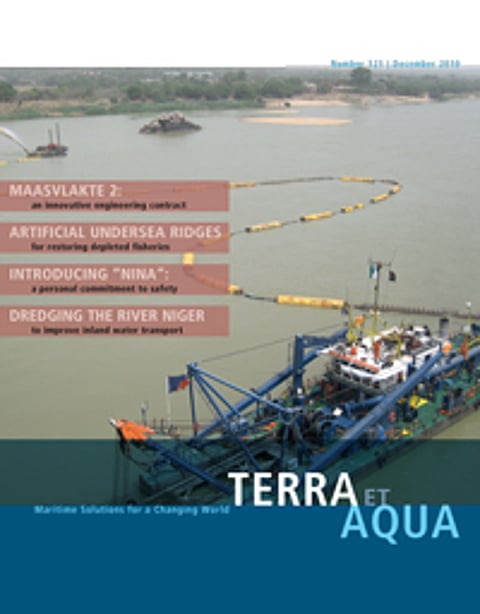
The Lower Niger River, with its variation of nine metres in water depth between dry and wet seasons, is extremely difficult to navigate. The Nigerian National Inland Waterways Authority, seeking to make the river manageable, turned to dredging and river training works.
In consultation with the local population, the dredging contractor has improved the navigability of the river, which will lead to better use of the river for water-borne transportation of goods.
