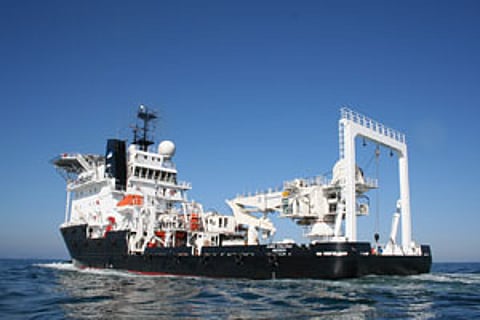
The 'Adams Challenge' is the latest delivery from Spanish shipyard, Balenciaga, and the fourth vessel built for the same owner, Adams Offshore (UK).
Classed by ABS, 'Adams Challenge' has an overall length of 85.74 metres, a moulded beam of 18 metres, a draught of 5.75 metres and a depth of eight metres.
'Adams Challenge' will be engaged in underwater surveying, pipeline construction and maintenance tasks by means of divers as well as the use of ROV. In addition, the vessel is fitted with a twelve-man saturated diving system which will enable works to be carried out up to a water depth of 300 metres.
The concept design came from the ship owner's in-house naval architect, with the remaining design work developed by Cintranaval, in close cooperation with Adams Offshore.
The vessel has a generating power plant comprising four Wärtsilä 8L26 engines each developing 2,600kW whilst turning at 900rpm, serving both the vessel's propulsion and all the many onboard services including the diving system and active heave compensated crane.
The complete scope of supply of the electric generation, distribution propulsion and control, inclusive of the power management system has been supplied by Ingeteam.
The ship is driven by two 2,450kW Wärtsilä LCT-FS275-S/WN azimuthing main propulsion units turning fixed pitch propellers in nozzles, driven by water cooled electric motors. Forward the vessel has two Wärtsilä FT175M-D fixed pitch tunnel thrusters, of 990kW each. The bow thruster set is completed with a retractable Wärtsilä FS175/750MNR of 1,000kW.
All propellers are manoeuvred by means of individual controls, placed on the main console forward, at each side of the helmsman seat, and are duplicated in the wheelhouse aft steering station.

All generating sets are sited in the engine room amidships, with the switchboard room located on the tween deck in the fore part of the engine room. There is also a Volvo D-25MG harbour generating set, rated at 565kW, fitted in the engine room and an emergency Volvo D-16MG genset fitted in its dedicated room on the forecastle deck.
Considering her size, she is propelled by relatively powerful engines, usually found in much larger vessels. This large available power will give 'Adams Challenge' good station-keeping and tracking capabilities under DP in adverse weather conditions. During sea trials a speed in excess of 15 knots was recorded.
The main propulsion units combined with the electrically driven bow thrusters, give the ship manoeuvrability and necessary control for station-keeping and tracking, when centrally managed by the dynamic positioning system. All propulsion units can be operated by means of their individual controls, as already mentioned, from the fore and aft driving stations in the wheelhouse, as well as from the portable joystick system provided, with connections on the wheelhouse wings, through the Kongsberg system.
Commonplace to a diving support vessel, a dynamic positioning system to DPS2 standard has been fitted, for which the 'Adams Challenge' has been equipped with a Kongsberg Simrad SDP21 Dynamic Position System interfaced with a cJoy independent joystick. The equipment fitted includes the following external position reference systems: two taut wire systems, two DGPS, a Fanbeam laser and one HiPap 500 and one HiPap350 hydro-acoustic systems.
The accommodation is divided in six deck levels, all of which are furnished with a washroom for public use. Most of the crew's quarters are sited on the main deck, and primarily consist of two-man cabins with en suite washrooms. A two-bed hospital with bathroom is fitted aft with direct access from the open deck.
On the top level, the wheelhouse houses the control stations, forward and aft, with a full suite of navigation systems as well as the DP control consoles with the displays of all reference systems. Forward there is a walk-around console with all the ship's controls as well as the two radars, ECDIS, alarm system monitoring panel, radio equipment, and onboard communications systems. The aft console has all ship controls duplicated and some of the radio equipment.
A large radio communications area, on the portside, is arranged with the GMDSS A3 and satellite communications. The DPS2 system consoles are located aft, adjacent to the aft control station. The wheelhouse has a conference/meeting room segregated by means of glass partitions, with curtains ensuring a secluded meeting space when required.
Above the wheelhouse there is a small deckhouse with helicopter lounge, fitted out with 26 seats, and a registration desk is located on the forward part.
The entire vessel serves as a platform from which sub sea works can be carried out by divers using surface air or saturation diving techniques. A fitted air diving system provides for surface air diving up to 50 metres of seawater. Diving air is produced by low pressure and high pressure compressors fitted under deck, and for emergency stored in dedicated high pressure cylinders.
