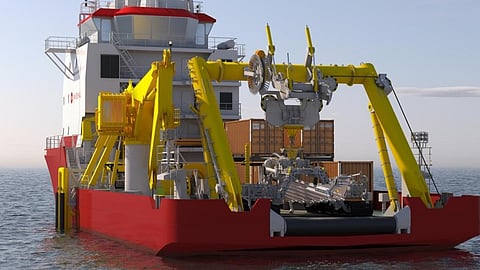
Jan De Nul will add a "Crayfish" subsea trencher to its fleet by the end of 2026, before deploying it on TenneT’s German North Sea cable program in summer 2027.
The company ordered the remotely operated machine from British engineering company Osbit. Crayfish is designed to bury cables up to five metres into the seabed and operate in water depths of up to 200 metres.
The lightweight, modular trencher is intended to bury cables in shallow waters, including sections close to shore. Jan De Nul said the design will limit its impact on the surrounding area while simplifying transport and mobilisation between projects.
Crayfish will be permanently based aboard Henry Darcy, a water-injection dredger undergoing conversion into a shallow-draft trenching support vessel. High-pressure jet water needed to loosen seabed material during cable burial will come from the vessel’s former dredging pumps.
Water will travel from Henry Darcy to the trencher through a hose. Locating the pumps aboard the support vessel, rather than on Crayfish, will allow the machine to operate in very shallow water where trencher-mounted pumps cannot be used.
The first deployment will cover shallow-water sections of Jan De Nul’s work for grid operator TenneT. The contractor is working with LS Cable and System and Denys on the BalWin4, LanWin1, LanWin5 and BalWin5 connections.
Each connection is based on TenneT’s 2GW offshore transmission system, giving the four projects a combined stated capacity of 8.0 GW. The routes will cross the Wadden Sea to connect offshore wind generation in the German North Sea with the mainland high-voltage grid.
The cable system comprises two cables rated at 525 kV for high-voltage direct-current (HVDC) transmission, along with a metal return cable and a fiber-optic cable. The cables will be bundled aboard installation vessel Fleeming Jenkin. Initial transport is scheduled for 2026, with final installation planned for 2031.

