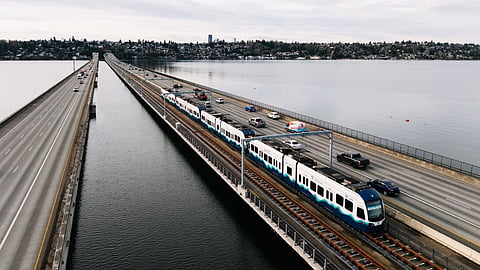


Washington's Sound Transit opened the Crosslake Connection to passengers on March 28, 2026, completing the 2 Line between Seattle and the Eastside and placing scheduled light rail service on the Homer M. Hadley Memorial Floating Bridge across Lake Washington, the first metro or light rail service in the world to run on a floating bridge.
The seven-mile (11-kilometre) section adds stations at Judkins Park and Mercer Island and joins the 2 Line to the 1 Line at International District/Chinatown Station. Sound Transit said its Link network now covers 63 miles (100 kilometres) and 50 stations, with the finished 2 Line linking Seattle, Mercer Island, Bellevue and Redmond. Trains run from about 05:00 to midnight, seven days a week, at roughly eight-minute intervals during peak periods at the new stations.
The wider East Link programme has been valued at US$3.7 billion, with US$712 million covering the two stations and the track crossing of the floating bridge. WSP, the prime engineering consultant for final design, listed the cross-lake scope at more than US$700 million. The Kiewit Hoffman joint venture built the bridge section, KPFF handled the floating-bridge retrofit design, and the Washington State Department of Transportation (WSDOT) retained ownership of the bridge throughout.
The Hadley opened in 1989 and stretches 5,811 feet (1,772 metres), placing it fifth among floating bridges of its kind worldwide, according to Sound Transit. A chain of hollow concrete pontoons supports it, with steel anchor cables under post-tension holding the structure in place instead of piers reaching the lakebed.
Washington adopted floating construction for the crossing because Lake Washington, a glacially carved body of water more than 22 miles (35 kilometres) long, is deep and has poor soil beneath its bed. The bridge carries the westbound and reversible lanes of Interstate 90. The Lacey V. Murrow floating bridge, a few hundred feet to the south, carries the eastbound lanes.
The state has treated its floating bridges as aquatic structures since the older Lacey V. Murrow bridge sank on November 25, 1990. A governor's review panel convened after that loss concluded that floating bridges demand lacustrine/marine rather than ordinary road-building practice, with watertightness protected at every stage of any work.
WSDOT's current guidance carries that forward: during construction, floating bridges should be handled like ships, while major reconstruction or rehabilitation should be scheduled outside the storm-season months.
Every element of the Crosslake work on the floating span, from post-tensioning to track supports, therefore had to preserve the buoyancy, watertightness, trim and anchoring of a structure carrying live highway traffic.
The movement of that structure was the defining engineering issue. Sound Transit said the Hadley had to accommodate six directions of movement in three forms, driven by wind, waves, traffic loading, temperature, seasonal water-level change and the interaction between the fixed approach spans and the floating section. Lake levels vary by up to two feet (0.6 metre) between seasons according to University of Washington (UW) research published this year (an earlier UW account put the swing at up to three feet, or 0.1 metre).
At the transition spans where fixed and floating structures meet, ENR reported elevation changes of as much as two feet along with north-south shift, rotation and roll.
Road vehicles barely register this movement, but rails do.
"[The bridge] moves up and down, and left and right," said John Sleavin, Sound Transit's lead engineer and executive technical adviser for the crossing. "Based on traffic loads and other things, the bridge [also] can rotate. In all, we have six directions of movement at a single joint, [but] we are only talking about a half-degree roll or angle change. Cars don't really notice it, but if you put half a degree in a steel item, it will snap."
UW professor John Stanton, who led the university's research on the rail prototypes, put the wider problem plainly.
"No one has ever put light rail on a floating bridge, so there is no precedent," he said. "You can't just pull a design off the shelf and say, 'Let's do this the same as before.' At every turn, you have to be ready for something coming at you from left field."
The bridge had been built with transit in mind. A 1976 agreement along the I-90 corridor reserved the centre roadway for high-capacity transit, and the original design included analysis for light rail loads, though the rail joint problem was left for later.
Sound Transit and its consultants began structural feasibility studies in 2001 using current light rail loading. In 2005, crews parked four fully loaded flatbed trucks on the south side of the bridge to represent one train, then two parallel sets of four to represent two trains, while instruments recorded anchor-cable forces, vertical deck movement, pontoon rotation and relative movement between pontoons. WSDOT's computer model was calibrated against the first loading case and checked against the second.
The analysis showed that combining light rail loading with a one-year storm generated stresses equal to 97 per cent of the allowable limit, a threshold set to protect the bridge against fatigue rather than a measure of ultimate safety.
The margin drove a structural retrofit. Twenty external longitudinal post-tensioning tendons, each more than 3,000 feet (900 metres) long, were added to increase compression along the length of the floating span and reduce the stresses generated by wind, waves, trains and highway traffic.
HNTB, part of the construction management team, said the work also involved a first-of-its-kind cathodic protection system for the concrete pontoons and the post-tensioned anchor cables, intended to extend the life of the existing structure. Sepehr Sobhani, Sound Transit's principal construction manager, said the combination of retrofit, anchors, bearing plates and track structures necessitated a complex exercise aimed at ensuring the alignment of the structural retrofit, anchors, bearing plates and bridges.
Because WSDOT owns the bridge and the Federal Highway Administration regulates it, the design team could not penetrate the tops of the pontoons. Therefore, not even a single hole was allowed in the bridge deck, and so engineers needed to devise an entirely new system, according to Kristina Tsvetanova, a UW graduate research assistant who worked on the attachment testing. WSP described the resulting approach as deliberately non-invasive and compliant with WSDOT's requirements for the pontoons.
The transition joints were solved with what WSP called track bridges. British engineer Andy Foan developed the Curved Element Supported Rail system (CESURA) specifically for the Hadley. Eight track bridges were installed, each with a 43-foot (13-metre) curved platform at a fixed-to-floating transition.
Instead of forcing the rail through a hinge-like bend at a single joint, the platform spreads the change in curvature over its length. Each rail follows its own curved plane, resting on bearer bars and double friction-pendulum bearings that permit several inches of movement in multiple directions while preserving the gauge. WSP said the system maintains the gauge and a smooth ride through four major structural expansion joints while the bridge moves and lake levels change.
Sobhani said the geometry had to be matched to the bridge itself.
"The track bridges had to be correlated with the movements of the floating bridge relative to the transition spans to make sure each movement of the bridge is accommodated by the track bridges, which ultimately prevents the movements to transfer undue stress into the rail," he said.
Testing ran for years before construction. Prototype work began in 2012 at UW's Structural Research Laboratory, where a full-scale section covering a quarter of the system's length was loaded on a custom steel rig that simulated train weight and the horizontal forces of wind and waves.
In 2013, two full-scale CESURA systems spent six months at the Transportation Technology Center in Pueblo, Colorado, running on a customised 5,000-foot (1,500-metre) track at simulated water levels and speeds up to 55 mph (89 km/h). It took three years and US$53 million of design and testing before the curved-element solution was approved.
Travis Thonstad, then a UW alumnus supervising the early tests, said the fabrication tolerances proved demanding.
"It works like a Swiss watch, so we had to work it out a piece at a time," said Thonstad. "But the challenges ended up paying off in the end, in terms of making sure the product was better."
The finite-element models built for the project represented the bridge down to its pontoons, anchors, flotation, rails, guard rails and fasteners, and the train down to bogies, axles, wheels and both suspension stages. When full-scale in-track testing began on the bridge, 500 channels of data were monitored against those predictions.
"It correlated very well with what we were seeing," said Sleavin. "We found a few things that allowed us to tweak and add camber in different places."
Between the track bridges, the running rail needed a fastening system that used no bolts and no dowels. The solution was an adhesive system: approximately 9,000 lightweight precast concrete blocks serve as ties, bonded to the deck with an epoxy. A plastic drip cap and a rubberised layer isolate the blocks electrically so that traction current cannot pass into the bridge structure.
The adhesive also had to absorb track vibration with no soil beneath the rails to dampen it, and stay flexible enough not to crack the concrete as it cured and shrank. The first formulation, tested in 2014, failed the vibration requirement.
"We provided reports to Sound Transit that indicated they needed to move in another direction," said Matthew Sisley, the UW alumnus who ran those tests. "The consultants basically took our test results and used that to inform the next iteration of the design,"
The revised prototype placed epoxy grout beneath a rubber-like Corkelast layer, rearranged the blocks and introduced a new metal rail clip. Blocks were cycled through heating and cooling to simulate seasonal conditions and examined for cracking and separation between layers.
Installation on a moving deck brought its own discipline. Crews surveyed from fixed points on the bridge rather than from satellite positioning. The deck carries a cross-slope for drainage while the precast pieces are flat, so flat pads had to be prepared before each block went down. Sobhani said the precast pieces, "didn't leave much room for error."
Before work reached the bridge, crews and UW researchers tested the epoxy's flow behaviour and rehearsed placement in the contractor's yard.
"There was a lot of process that went in advance of even getting out there because this is a unique construction method, Sleavin said. "We spent a lot of time with the contractor and that helped us negotiate the price and understand the real hours of work it would take to put this stuff on".
The bridge's marine requirements dictated the schedule. Block installation began on May 1, 2019, with all blocks to be staged on the bridge by the end of September so they would provide the required ballast before winter storms, while bonding work continued in suitable weather. The civil contract for the bridge was scheduled to close in November 2020, with train testing planned for 2022 and revenue service in 2023. Passengers boarded in March 2026.
The fixed approach spans posed a separate constraint. Seismic strengthening beneath them would ordinarily have meant working in Lake Washington. WSP said its retrofit design instead changed how the spans respond seismically, eliminating the need for any in-water construction.
With the track in place, systems integration followed. On October 14, 2025, a light rail vehicle ran under its own power from Mercer Island towards Seattle, drawing current from the overhead catenary, while engineers monitored power for traction, interaction with the catenary, wheel-rail dynamics and communications in real time. Mott MacDonald, a partner with STV in the Northwest Transit Systems Partners construction management joint venture, said the vehicle performed smoothly on the first attempt.
Its team also verified traction-power behaviour under bridge movement, stray-current controls and the cathodic protection system. WSP said dynamic testing with moving trains confirmed floating-span deflection and load performance stayed within the ranges predicted in final design.
Operating rules now reflect the physics of a floating structure. When load concentrates on one side of the pontoons, that side sinks while the other rises, increasing stress in the structure. Sound Transit therefore permits no more than two trains on the bridge at once under normal conditions, and only when they travel on opposite tracks.
Weather determines the remaining operating restrictions. Sustained wind over the open lake builds waves that load the bridge, and the prevailing strong winds arrive from the south, where the Lacey V. Murrow bridge acts as a breakwater. Northerly winds occur less often and face less protection, prompting Sound Transit to place anemometers north of the rail alignment to measure wind speed, direction and duration; computers use those readings to estimate wave heights.
Below 1.4 feet (0.4 metre) of estimated wave height, trains run normally. A 30mph (50km/h) northerly sustained for 83 minutes, corresponding to roughly 1.5-foot (0.5-metre) waves, cuts service to one train on the bridge at a time. A 40mph (60km/h) northerly held for 71 minutes, estimated to produce 2.21-foot (0.67-metre) waves, suspends crossings until conditions ease. The system is redundant so that a single anemometer alarm, such as one triggered by a bird strike, can be distinguished from a genuine weather event.
A parallel monitoring effort now watches the bridge itself. UW researchers led by Thonstad, now an assistant professor, and Professor Michael Motley have built a digital twin of the Hadley that pairs a three-dimensional model with live sensor feeds, weather data, GPS locations for individual pontoons and readings of anchor-cable tension, all sent to the cloud for maintenance staff. Sensors went in during May 2025 and immediately showed differences between pontoons: one rose and fell daily with thermal expansion, while another, held by 12 anchor cables rather than four, barely moved. The system tracks responses to trains, weather and anchor adjustments to millimetre accuracy, and a second phase is planned to bring in Sound Transit's rail sensors.
For WSDOT bridge keeper Vince Horn, the twin delivers custom alerts on wind spikes and changing conditions, and UW said it could reduce the need to send crews out on the water during storms to measure wave height by hand.
"The most surprising thing for me has been learning how the bridge behaves on a day-to-day basis at the level of precision that we were never able to before," Thonstad said. "We have to maintain the structure well; we have to make good decisions."
