
VESSEL REVIEW | Frederick Paup – Largest US-built hopper dredger delivered to Manson Construction
Seattle-based Manson Construction has taken delivery of a new trailing suction hopper dredger (TSHD).
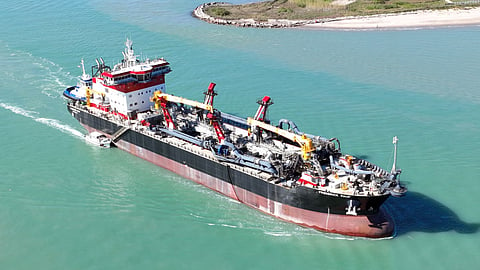
The Jones Act-compliant Frederick Paup was constructed at the Seatrium AmFELS shipyard in Brownsville, Texas, and is slated for deployment in Mobile, Alabama.
The vessel honours Frederick Paup, Manson's Chairman of the Board and Executive Vice President. Design work was undertaken in-house by Manson in collaboration with naval architecture firm Hockema Whalen Myers Associates, also located in Seattle. Manson said the in-house effort ensured that major dredging components—including the davits, trunnion system, weirs, pumps, dual drag arms, and thrusters—were optimised for safety and peak efficiency.
Balance between significant capacity and high transit speed

The TSHD measures 420 feet (130 metres) long and 81 feet (25 metres) wide and has a draught of 28.5 feet (8.69 metres), a gross tonnage of 12,141 and a hopper capacity of more than 15,000 cubic yards (11,000 cubic metres). These attributes make the vessel the largest self-propelled hopper dredger built and operated in the United States as well as what Manson said is its “largest investment since its founding in 1905.”
Hockema developed a hopper dredger hull form and arrangement combination to maximise the ratio of hopper capacity versus cubic hull dimensions. The bow and stern hull lines were developed to reduce bare hull resistance in both the loaded and unloaded conditions using CFD analysis.
Hockema said the CFD validation was critical in ensuring its goal of achieving a high-capacity vessel with restricted overall hull dimensions while meeting target steaming speeds.
Versatile diesel-electric propulsion arrangement
The vessel has a total installed power of 25,000 hp (19,000 kW) and is equipped with three Schottel azimuthing stern Z-drives with fixed-pitch propellers and two Brunvoll bow thrusters. Fuel is supplied from tanks with a total capacity of 964.42 cubic metres (254,770 gallons).
The TSHD incorporates five Wabtec US EPA Tier IV-compliant generators consisting of three 5,600hp (4,200kW) units and two 4,200hp (3,100kW) units.
Technical systems meanwhile include those for dynamic positioning, power management, and integrated dredging.
Comprehensive dredging fitout for a range of applications
The dredging system that supports the loading and emptying of the hopper volume includes dual drag arms deployed at the upper working deck level, five pairs of dump doors located at the bottom of the hopper, and a bow coupling unit that can be connected to a floating discharge hose for long range distribution of spoils or by “rainbowing” hopper contents through a high-pressure-rated nozzle fitting.
A sliding trunnion carriage has been fitted for the drag arms. Manson’s equipment engineering division introduced the idea for the new trunnion carriage during the early parts of the planning phase as a means of enhancing safety and improving access points for the crew.
As the trunnion is automated, the drag arms can be stowed more efficiently, thus eliminating the need for a dedicated crane. The TSHD is nonetheless fitted with two telescopic service cranes and one stores crane, all from MacGregor.
The hopper shape includes a sloped bottom in the lower part as well as four moguls running the width of the hopper, which are evenly spaced over the hopper length. Coupled with the ability of the jet water system’s numerous nozzles to create a spoils slurry within the hopper, these sloped surfaces direct hopper contents to the dump door bays between the moguls either for release through the doors or pump-off by suction bell-mouths leading to a common pump-off manifold.
Other than these pump-off branch suctions and the jet water system nozzles, all other dredging system piping is arranged outside of the hopper volume to reduce weather and spoils exposure as well as maximise the hopper volume capacity.
With fully automated systems, all vessel navigation and dredging operations can be executed from the wheelhouse. The entire working deck, hopper loading chute, spoils level control weirs, dump door cylinders, and the above-deck portion of the pump-off system can be viewed from the drag tender’s station at the forward end of the wheelhouse.
The mate’s navigating station is directly aft and higher than the drag tender, providing 360-degree visibility necessary for operations in busy shipping channels, also providing for overall vision of dredging operations and direct verbal communication with the drag tender. Vessel manoeuvring during dredging operations is via a dynamic positioning system, allowing for a precise track for the twin dragheads.
Boasting enhanced safety and comfort
Additional features of the dredger include a starboard passageway in the hull that allows the crew access to internal compartments and to walk fore-and-aft the entire vessel under deck, providing overhead protection for safety.
The dredger also includes accommodation for up to 31 personnel and an exercise room for the crew to stay active during their downtime. All interior spaces benefit from an HVAC system to permit sustained operations year-round.
Classed by the American Bureau of Shipping, Frederick Paup will be used in navigation channel maintenance, beach nourishment works, and coastal restoration projects, though her initial deployment will be in the Mobile Bay ship channel. These operations are intended to support the US Army Corps of Engineers' goal of achieving 70 per cent beneficial reuse of dredged material by 2030.
