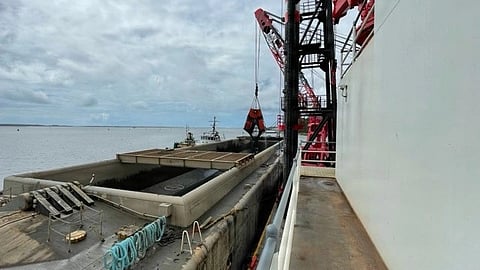
The US Army Corps of Engineers Wilmington District recently completed annual maintenance dredging at Military Ocean Terminal Sunny Point in North Carolina, removing hundreds of thousands of cubic yards of sediment to keep federally authorised navigation channels open.
The agency said that the $6.3 million project supports the installation's capacity to safely receive and deploy vessels for national defence.
Clare Williams, Navigation Project Manager with the USACE Wilmington District, explained that the waterways must remain deep enough for vessels to maintain their missions. "If the vessels can't make it in, the mission is compromised," Williams added.
The annual work restores channels to their authorised depths by clearing naturally accumulated material, which typically amounts to 500,000 to 600,000 cubic yards (382,277 to 458,733 cubic metres) of dredged sediment relocated to an offshore disposal site.
A small subcontractor completed a portion of this year's dredging in March, while Curtin Maritime performed the remaining work between May 19 and June 13.
Curtin Maritime utilised the DB Catalina to complete the work, which the district prefers because mechanical bucket dredges generally pose a lower risk to marine life than cutterhead or hopper dredges.
USACE added that these mechanical dredges also require less pipeline infrastructure to operate, which minimises interference with vessel traffic and helps ensure installation operations continue uninterrupted. Co-ordinating around this vessel traffic represents a major challenge, as the dredge must yield to incoming or departing military vessels.
"That requires heightened coordination between the contractor, the corps and the customer," Williams said.
The project must also navigate environmental restrictions, as the terminal area provides habitat for protected species such as breeding sturgeon.

