
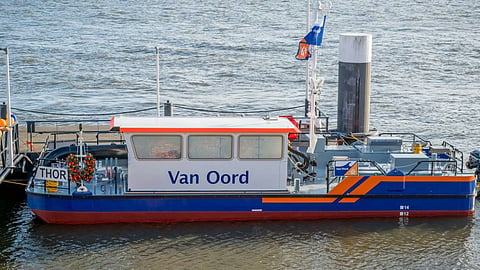
VESSEL REVIEW | Thor – Compact water injection dredger for inland and marina operations
Van Oord has taken delivery of a new water injection dredger (WID).
Thor was designed and built by Netherlands-based Kooiman Marine Group for maintenance operations in small ports, marinas and rivers (Kooiman Marine had also built Van Oord’s earlier WIDs Maas, Mersey, Rijn and Rhône, which are more ideal for harbour and deep-sea dredging).
Van Oord opted to have some of its vessels be capable of water injection dredging as a means of making operations more sustainable. The company had said that removing sediment "the natural way" is an efficient and environmentally friendly means of maintaining the depth of a range of waterways including navigation channels, ports, and rivers.
The WID has an LOA of 14 metres (46 feet) and a beam of five metres (16 feet). A shallow draught and a low profile allow the vessel to safely pass underneath and operate near low-hanging bridges.
Low-emission systems coupled with improved deployability and access to a range of waterways

The operator has described the compact, modular vessel as a low-emission development with high manoeuvrability, intended to serve smaller dredging projects.
The WID’s operating role combines the maintenance of navigable depths with a transportable configuration, allowing the vessel to be disassembled, moved overland and reassembled between projects.
Van Oord plans to base the vessel primarily in the UK for the maintenance dredging market. She will replace the company’s older WID Borr, which was also dismountable and can be carried on two trailers.
Van Oord said its WIDs can work close to embankments and quay walls, a capability attributed to their manoeuvrability.
Optimised for working with materials requiring gentle handling
Water injection dredging uses water introduced into the seabed to fluidise sediment. The mobilised material is then carried away from the dredged area by a density current and natural water movement.
The method is generally suited to recently deposited fine sediments, including silts, clays and fine sands. Its effectiveness depends on both seabed conditions and the surrounding water conditions, which govern how the fluidised material moves away from the area being maintained.
The Port of London Authority subsequently selected Thor for water injection dredging at Robins Wharf in Northfleet. The work was scheduled to begin on or around September 9, 2026, with operations either side of high water over an estimated three working days.
