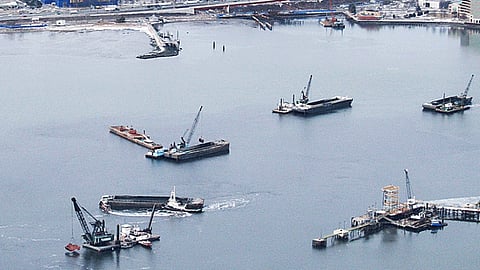
The US Army Corps of Engineers (USACE) New England District will begin deepening and widening New Haven Harbor in Connecticut this week.
Dredging is scheduled to continue until the beginning of March 2028.
The project spans about 5.5 miles (8.9 kilometres) of federal navigation channel serving the port's deep water terminals. Dredging will deepen the entrance and main channels, along with the manoeuvring area and turning basin, from 35 feet (11 metres) to 40 feet (12 metres) below mean lower low water.
Outside the breakwaters, the entrance channel will be extended and its width increased from 500 to 600 feet (150 to 180 metres). The bend between the breakwaters will grow from 560 to 800 feet (170 to 240 metres), while the main channel within the harbour will increase from 400 to 500 feet (120 to 150 metres).
The turning basin will also be reconfigured so that larger vessels can use it more efficiently.
Work will take place over two five-month dredging seasons running from October to March. In August, after four bids were received, Great Lakes Dredge and Dock secured a US$68.9 million contract on a firm-fixed-price basis to carry out the improvement dredging.
The procurement specified mechanical dredging with dump scows, as well as rock removal requiring blasting.
USACE said the deeper channel would let larger vessels enter with full loads without having to wait for high tides. The agency said this would help safeguard deliveries of petroleum products and heating fuel during peak winter demand.
About 1.7 million cubic yards (1.3 million cubic metres) of dredged material—nearly 40 per cent of the total—will go toward habitat works.
The project will allocate roughly 900,000 cubic yards (690,000 cubic metres) of sand to shellfish habitat; nearly 700,000 cubic yards (540,000 cubic metres) of fine-grained material will go into borrow pits excavated during construction of I-95 in the 1950s.
New reef habitat will be created using dredged rock. The remaining material is cleared for placement at the Central Long Island Sound Disposal Site.
The project was authorised under the Water Resources Development Act of 2020 and is funded through the Bipartisan Infrastructure Law.

