VESSEL REVIEW | Custom electric dredger for Canadian potash mining firm
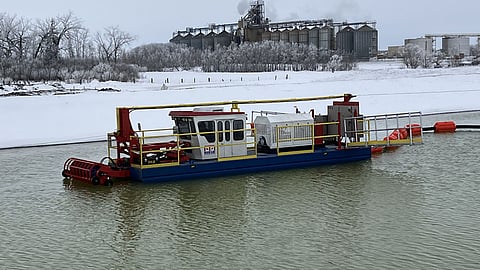
US-based Ellicott Dredge Enterprises (EDE) delivered and commissioned a custom electric dredger for Canada’s Potash and Agri Development Corporation of Manitoba (PADCOM) in March 2026.
The manned dredger removes crystallised potash from the HDPE-lined settling lagoon at PADCOM's solution mine at Harrowby, approximately 16 kilometres (9.9 miles) west of Russell, Manitoba. It pumps the material 427 metres (1,400 feet) to the mine's processing plant against 6.7 metres (22 feet) of static head.
The mine uses polythermic selective solution mining. Brine injected underground dissolves the potash and leaves the salt in place, and the well returns a solution saturated with potash.
PADCOM President Daymon Guillas told CBC News in May that the brine is heated to 40°C and the recovered solution is cooled in outdoor ponds to crystallise the potash. This method replaced a mechanical cooling process that had not produced enough potash for profitability.
Outfitted for more efficient material extraction

The dredger was intended to, “increase production over the previous method of using a pump hanging from a barge,” EDE told Baird Maritime. “The system is designed to work down to the bottom of the lagoon, with a liner protection system added to preserve HDPE liner integrity.”
EDE's engineering team developed the dredger jointly with PADCOM to deliver the potash flow and slurry density required by the processing plant. The builder said a standard system would not have been compatible with the application.
EDE said the dredger was, “designed to cut potash, with increased horsepower and cutter torque.”
The cutterhead uses high-torque motors and staggered heavy-duty carbide steel teeth. These will grind the deposits into the larger crystals required by the plant rather than pulverising them into powder. Dual hydraulic cylinders raise and lower the heavy duty ladder and push the cutter into the crystallised material.
The cutterhead is fitted with liner protection wheels and a removable cage. The cage is used in softer areas and removed when the potash becomes harder. On each dredger from this series, the protection wheels press the liner down as the dredger advances, which helps prevent it from being drawn into the slurry pump.
The dredger traverses the lagoon on a four-point cable drive system with shore anchors and an onboard traversing winch. EDE said the winch provides the, "necessary line pull of the dredger across the lagoon while cutting stiff material."
Systems permitting full range of operation by a single crewmember
The operator works from a climate-controlled cabin with a human-machine interface touchscreen for dredging set points and monitoring. EDE said the programmable logic controller (PLC) runs a proprietary program.
EDE’s automation software moves the dredger to the end of each cut, returns it to the starting point, and then waits for the operator's next command.
PADCOM also selected a Solids Sense slurry density control system, which uses a density meter to monitor the percentage of solids in the slurry and adjusts travel speed automatically. This gives the downstream plant a more consistent product.
EDE said the dredger was designed to operate in extreme cold. The PLC and electrical equipment are housed in a NEMA 4X stainless steel enclosure with its own climate control, allowing year-round operation in temperatures as low as -45°C. The electrical system was designed and certified to Canadian Standards Association requirements.
Maintaining a design that could be moved on one truck was the biggest challenge of the project, according to EDE. Detachable port and starboard gangways allow the dredger to keep that capability.
Ryan Horton, Vice President of auger dredges at EDE, said the model selected by PADCOM "is just one of dozens of recent custom dredge systems we have produced for our global customers."