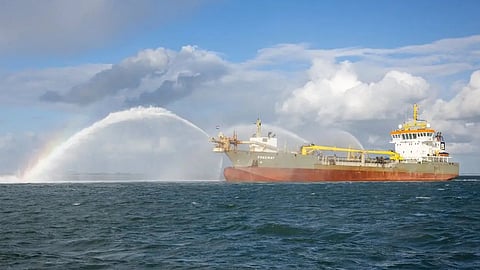

Boskalis and Dutch public works agency Rijkswaterstaat recently began a sand nourishment project at the Galgeplaat and Slikken van den Dortsman intertidal areas in the Oosterschelde Estuary in the Netherlands’ Zeeland province.
The trailing suction hopper dredger Freeway is among the equipment deployed. Completion is expected around March 2027.
The project comprises seven nourishment elements, five on the Galgeplaat and two on the Slikken van den Dortsman. Together, these cover 261 hectares of the two intertidal areas, which span more than 2,100 hectares in total.
The technical plan calls for about three million cubic metres of sand to be placed. Settlement is expected to reduce this to about 2.6 million cubic metres.
The sand will come from maintenance dredging of navigation channels in the Oosterschelde and from a designated extraction area near Wemeldinge. This will allow fairway maintenance to be combined with raising the flats.
The work addresses what is known in the Netherlands as "sand hunger".
Water movement in the estuary fell following construction of the Oosterschelde storm surge barrier, the Oesterdam and the Philipsdam. As a result, less sand is carried back onto the flats and marshes, while storms move sand from those areas into the deeper channels.
Rijkswaterstaat said the intervention is intended to maintain low-tide exposure on parts of the flats, enabling migratory birds to forage there and seals to rest. It estimates the intervention will preserve this function for at least 25 years.
The project also involves Rijksdienst voor Ondernemend Nederland, Provincie Zeeland, and Natuurmonumenten. It forms part of a broader Dutch Government programme.
The scheme follows the Roggenplaat nourishment in the Oosterschelde, completed in 2019.
According to Rijkswaterstaat, 90 per cent of the sand added there remained at the placement area or within 50 metres. The area falling dry for more than half the time grew from 602 to 726 hectares.
The agency said lessons from that project informed the design and execution of the Galgeplaat works.

