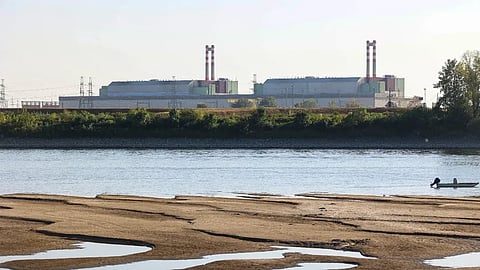


Hungary will power down its Paks nuclear power plant for the first time in nearly half a century on Sunday, Prime Minister Peter Magyar said on Saturday, as water levels on the Danube River the plant uses as a coolant have plumbed record lows.
The shutdown comes as large parts of Europe have been hit by prolonged heat, driving river levels lower and raising concerns about water supplies, shipping and power generation.
Falls in water levels amid a lack of rain have also disrupted shipping and tourism in Hungary and triggered water-use restrictions in more than 100 cities and villages, including on the outskirts of Budapest, based on government records.
The energy crisis could also hit the wider economy, which grew less than forecast in the second quarter following a three-year stretch of stagnation.
"Due to a further decline in the Danube's water level, the second-to-last generating unit at the Paks nuclear power plant will be shut down at 01:30 (23:30 GMT)," Magyar said in a social media post.
"As a result, the plant is now producing only 240 megawatts (of electricity), and tomorrow (on Sunday), for the first time in 44 years, it will be completely shut down."
Hungary's water authority was projecting the water level on the Danube River, which flows from Germany to the Black Sea, to decline further in the next days. Hungary's northern neighbour Slovakia offered help, with Prime Minister Robert Fico describing the situation as an unprecedented energy crisis caused by the looming shutdown of Hungary's only nuclear power plant.
"I am closely monitoring the energy crisis in Hungary and express our full solidarity with our neighbour, along with our readiness to help," Fico said in a social media post, adding nuclear plants in Slovakia were operating at their planned capacity.
The crisis could cost Hungary 100 billion to 200 billion forints ($315 million to $630 million) due to the surging price of imported electricity, Mark Radnai, Vice Chairman of Magyar's Tisza party, said on social media.
Magyar, who has warned that Paks could remain idled for weeks, said his cabinet would issue a decree seeking voluntary power demand cuts from large users in addition to 240 MW of cuts already committed. Penalties would apply if those targets were missed.
The decree would also allow grid operator MAVIR to seek mandatory reductions in power consumption from big users and temporarily cut certain large consumers off the grid, if needed.
"Households will be the last in the chain of restrictions," Magyar said. Earlier on Saturday, engineers restored 360 MW of power output lost due to a malfunction at Hungary's largest gas-fired power plant in Szazhalombatta, but Magyar said additional measures were needed to ease the load on the power grid.
From Monday, rail cargo services will be stopped between 15:00 GMT and 20:00 GMT to reduce power demand. The government will also order public sector staff to work from home for the first three days of next week and ask companies to follow suit wherever possible.
Floodlights on Hungarian public buildings and non-essential lighting will also be switched off, Magyar said, adding that record-low water levels have also triggered water consumption restrictions in the worst-hit areas.
"Each drop of water counts," he said.
(Reporting by Gergely Szakacs; Editing by Hugh Lawson and Sanjeev Miglani)
