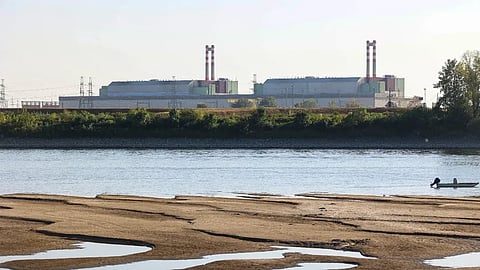


Hungary's government will carry out engineering work on the Danube river to help raise water levels and ensure cooling for the Paks nuclear plant, Prime Minister Peter Magyar said in a social media video on Wednesday.
The Danube fell to record lows in recent weeks amid a prolonged heatwave and drought across much of Europe, forcing the plant to operate at only around 25 per cent of its capacity currently with only two of its eight turbines left running.
Droughts this summer have wreaked havoc in European power production, shipping and public health systems. Neighbouring Romania, for example, could shut down its last working reactor on Thursday as levels on the Danube continue to fall, despite efforts to divert cooling water to the plant.
Engineering work to be carried out in Hungary involves a riverbed "sill", a submerged, dam-like structure built crosswise on the bottom of a river channel, to manage water flow.
Round-the-clock construction of the sill using nearly 150,000 cubic metres of stone will start immediately with the help of the military, and these measures will cost about HUF6 billion ($19 million).
Magyar said the river sill will be able to raise the water level by up to one metre, and it could ensure within a couple of weeks that the plant can again operate at full capacity.
"The prolonged low water levels on the Danube are causing enormous damage to the Hungarian budget and economy, which is why we needed to find a solution that can be implemented immediately," Magyar said.
He said at the same time, preparations are in place for the potential sinking of two 80-metre barges as a short-term measure as water levels are expected to drop further within four to five days, which could lead to a shutdown of the nuclear plant.
Sinking of the barges could raise the water level by 20 centimetres in the short term, which could ensure that the facility can operate while the riverbed sill is under construction, Magyar said.
The government will decide on whether to sink the barges on Friday.
(Reporting by Krisztina Than and Anita Komuves)
