
A major incident was narrowly avoided following an early morning collision between two trawlers off the island of Senja in the Arctic north of Norway.
The 68-metre purse seiner 'Hundvåkøy' was returning to port with a 1,500-tonne catch of capelin when it collided with the 'Hordafor 4' and sustained major hull damage. The engine room flooded but the master successfully grounded his family-owned and operated boat to prevent the total loss of the vessel and its cargo.
A prompt inspection by the Norwegian Coastal Administration resulted in a decision to patch the large hole in the hull with a Miko plaster.
Both the coastal administration vessels attending the incident, the 'North Crusader' and the 'Harstad', were carrying a Miko Salvage Kit from which it was possible to select a six- by two-metre "hat-shaped" patch and, within six hours, have it secured on the hull to cover the hole.
As a result, virtually all of the catch was saved and transferred to other boats and the engine room was pumped dry. This enabled the 'Hundvåkøy' to be refloated and towed some 15 nautical miles to the NATO quay at Sørreisa for more permanent repairs.
Salvage experts attending the incident believe that without the patch the trawler would almost certainly have capsized and sunk. This would have resulted in a costly recovery operation and a risk of pollution in a sensitive Arctic region.
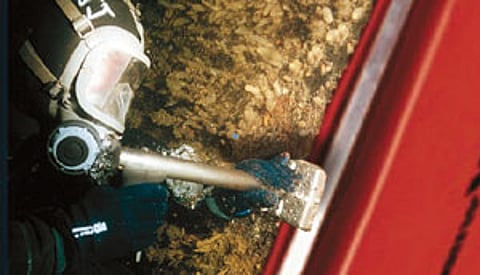
The patch chosen for the repair was manufactured from a high strength fabric that combines polyester reinforced PVC with aramid. It is described as "hat-shaped" due to its design as a shallow bag with a brim that is held securely against the hull beneath flexible aluminium strips that are fixed by divers using an HD 200 underwater stapling tool. The bag-like capacity of the patch enables it to cover any irregular tearing of the hull while the brim ensures a strong and watertight seal.
For further information contact:

