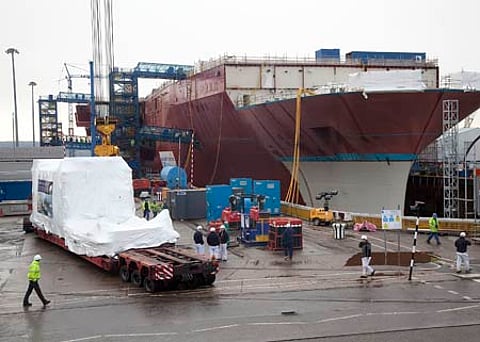

Rolls-Royce has successfully completed the installation of the first MT30 gas turbine into the Royal Navy's new aircraft carrier, the HMS 'Queen Elizabeth', at Babcock's Rosyth shipyard in Scotland. The MT30, according to Rolls-Royce, is the "world's most powerful marine gas turbine", with a rating of 36MW.

Two MT30s will be installed in each ship and will provide two thirds of the 109MW needed to power the 65,000 tonne ships, "enough energy to power a town with a population of over 200,000," said Rolls-Royce in a statement.
The MT30s are installed as part of a Gas Turbine Alternator (GTA), which also includes an alternator and gas turbine enclosure weighing a total of 120 tonnes.
Tony Wood, Rolls-Royce president (marine), said: "The successful installation of the first MT30 marks a significant milestone in the Queen Elizabeth-class programme. Rolls-Royce has a long and proud history of delivering marine gas turbine technology to the Royal Navy. We are extremely pleased to be part of this programme working alongside our many partners in delivering sophisticated power and propulsion systems for these magnificent ships."
Jim Bennett, Thales's power and propulsion director for the Aircraft Carrier Alliance, said: "The Power and Propulsion Sub-Alliance is immensely proud of this significant milestone in the QEC project. It has been the culmination of many years of hard work to ensure the timely delivery of this first complete MT30 gas turbine alternator, which along with its twin will deliver around two thirds of the electrical power generated on board the HMS 'Queen Elizabeth'. Congratulations to all involved, this is British engineering at its best!"
Tony Graham, head of Capital Ships at the Ministry of Defence, said: "To have successfully lifted the most powerful engine in the Royal Navy onto the biggest ship ever built for the Royal Navy using the biggest capacity gantry crane in Europe is an important event in the construction of the 'Queen Elizabeth'. Everyone involved should take huge pride in their contribution to this national endeavour."
The installation involved the lifting of the MT30 gas turbine and associated ancillary equipment – housed in a steel package known as the gas turbine enclosure – onto the ship structure. With the enclosure in place, the large alternator, which is driven by the gas turbine to produce electrical power, was then hoisted into place.
The MT30 gas turbine is derived from the Rolls-Royce Trent 800 aero engine which powers the Boeing 777 aircraft, with around 80 per cent of the parts being the same.
The MT30 currently powers the US Navy's Freedom Class variant of the Littoral Combat Ship, will power their new DDG-1000 destroyers and was recently selected for the Republic of Korea Navy's new FFXII frigate.
Modular production of the MT30 begins on the same production line as the Rolls-Royce Trent aero engines in Derby, before the modules are assembled into the marine configuration, and put through a rigorous test and certification programme at the Rolls-Royce facility in Bristol.
The power generated will meet the aircraft carrier's demand for energy, which includes the propulsion motors, weapons and navigation systems as well as the entire low voltage requirements for lighting and power sockets.
The four GTA packages (two per ship) are assembled by Cullums Detuners of Derbyshire. Due to the size, the alternator and gas turbine enclosure are shipped to Rosyth separately.
