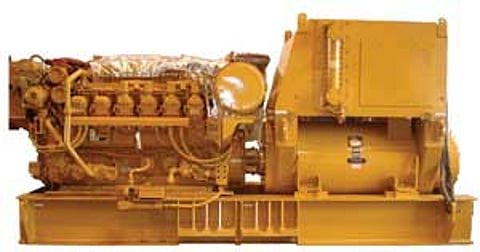
The Cat 3500 engine series has been recognised as the commercial marine industry leader since its initial manufacture in the 1970s. The latest step in the evolution of the engine line is the launch of the Cat 3512C and 3516C Diesel Electric Propulsion (DEP) engines to better meet critical customer requirements and further the commitment by Caterpillar to sustainable development.
Available for a variety of commercial applications and megayachts, the DEP engines build on the proven reliability and durability of the 3500 engine platform while meeting EPA Tier 2 and IMO Tier I regulations.
Manufactured at the Lafayette Engine Centre, USA, the constant-speed DEP engines offer the latest in EUI fuel system capabilities and state-of-the-art ADEMTM A3 Electronic Control Units (ECU).
The Vee-12, four-stroke 3512C engines are available at 1,360 ekW, 1,550 ekW, and 1,700 ekW, and the Vee-16, four-stroke 3516C engines are available at both 2,000 ekW and 2,250 ekW. All engine ratings are certified to the E2 emissions cycle.
The electronic "power station" concept creates efficiencies between the control units, unit injectors, instrumentation and displays to perfectly balance power supply, fuel consumption and exhaust emissions at any given load.
A win-win situation for operators and the environment
Operators of diesel electric propulsion engines understand the inherent advantages of their use: additional safety of operators, lower noise and vibration levels, and driving efficiencies by leveraging electronic technology and the overall system design. However, the largest benefit of the diesel electric power plant may be the redundancy of the engine power generation because the diesel electric engines are turned on only as they are needed. So if an engine is lost, there is still enough power generated to provide power for shaft lines and vessel electronics.
Additionally, the EUI fuel system capabilities and ADEM ECU deliver more available power while achieving outstanding fuel efficiency. In terms of maintenance, the time between overhaul is increased as DEP engines are not always running at full load there is no physical contact with propeller and engine.
These features mean the overall cost and maintenance is reduced for the vessel owner – putting more focus on the voyage ahead and less worry about the operation of the engines.
For further information contact:

