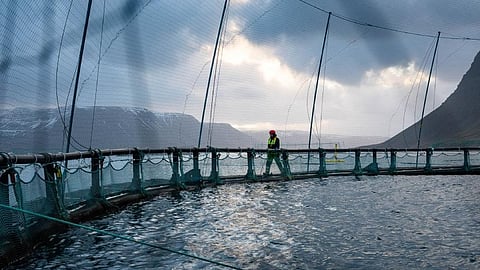

More than 420 organisations and businesses have petitioned US Congress to reject the Marine Aquaculture Research for America Act of 2025, according to a joint letter delivered on February 4. The groups asserted that the legislation would permit industrial-scale fish farms in federal ocean waters for the first time.
These federal waters extend from approximately three miles (4.8 kilometres) to more than 200 miles (321.9 kilometres) offshore. The North American Marine Alliance noted that these areas currently support commercial fishing communities and marine ecosystems.
The letter was addressed to leaders of the House Committee on Natural Resources and the Senate Committee on Commerce, Science, and Transportation. Signatories argued that the bill establishes a pathway to commercial production while authorising long-term leases in public waters.
Critics of the legislation highlighted risks associated with open-ocean fish farming, such as the use of fishmeal made from wild-caught forage fish. Facilities also release untreated waste directly into surrounding waters, the letter stated.
Commercial fisherman and Board President of the North American Marine Alliance Jason Jarvis mentioned that the legislation would impact communities losing access to fisheries.
“If the MARA Act passes, the only real ‘experiment’ will be on the communities that will lose access to their fisheries, the nearby marine life exposed to filth and fish viruses, the consumers who eat these farmed products and, sadly, the farmed fish themselves,” Jarvis said.
Program Manager at Inland Ocean Coalition Mia Glover commented that healthy ocean ecosystems sustain biodiversity and support food webs. “We all depend on healthy ocean ecosystems because they produce much of the oxygen we breathe, sustain immense biodiversity, and support food webs that feed billions of people worldwide,” Glover stated.
Don’t Cage Our Oceans, a coalition including seafood businesses and conservation groups, indicated that it supports community-based seafood farming like seaweed and bivalve aquaculture. However, the coalition opposes the industrial model which it compared to "factory farms on land".
The group warned that companies such as Cargill, JBS Foods, and Merck have financial interests in industrial aquaculture as suppliers of pharmaceuticals and fish feed. This model reportedly shifts the costs of cleaning up pollution and disease outbreaks onto the public.
Supporters of the bill have argued that the United States needs these farms to address a seafood deficit. In contrast, the groups cited data showing that US commercial fishermen harvested 8.4 billion pounds (3.8 billion kilograms) of wild seafood in 2022. This harvest exceeded the 6.6 billion pounds (three billion kilograms) consumed by the nation that year.
The signatories requested that congress instead pursue policies like the Keep Finfish Free Act of 2025. These alternative bills are designed to support working waterfronts and prevent corporate consolidation of public waters.

