VESSEL REVIEW | Steelhead – Lake fisheries survey vessel for Michigan Department of Natural Resources
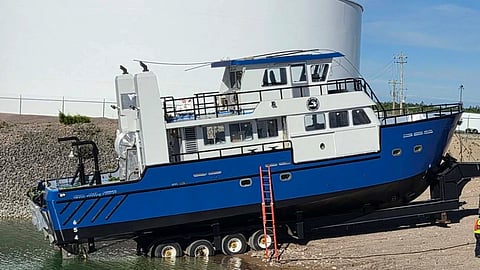
The Michigan Department of Natural Resources (DNR) commissioned a new fisheries research vessel at its homeport of Charlevoix on September 30, 2026. Moran Iron Works (MIW) had delivered the vessel to the department in mid-August.
Steelhead has since replaced a survey vessel of the same name that had operated from the DNR's Charlevoix Fisheries Research Station from 1968.
Boksa Marine Design of Lithia, Florida, was responsible for full-service naval architecture and marine engineering, from conceptual design all the way through the final commissioning. MIW built the vessel at Onaway, Michigan, in partnership with Superior Boats.
The contract was awarded in August 2024 at a cost of US$5.85 million following competitive bidding. Funding came from the state legislature, which had allocated US$4 million in the 2023 budget, and from Great Lakes Fishery Trust grants.
Laid out for easier movement of personnel and equipment
The new Steelhead has a length of 66 feet (20 metres), a beam of 18.25 feet (5.56 metres), and a draught of only 5.83 feet (1.78 metres). She has a steel hull with watertight compartments and an aluminium pilothouse to save weight.
The entire boat design was carefully engineered around the exact ergonomics of a hydraulic gill net lifter. Boksa designed a sub-floor "lifter trench" directly inside the wet lab space. This allows nets and biological samples pulled from depths up to 300 feet (90 metres) to enter the vessel securely, eliminating the need to drag heavy gear across exposed decks.
The deck features heavy-duty stern gallows, winches holding 1,000 feet (300 metres) of cable, and a central trawl drum.
A Hawboldt Industries remotely operated crane brings catches aboard, so the crew no longer have to lift fish by hand. When the crane is available, the entire trawling system can be completely removed and stored on shore when not in use, opening up vital deck space for alternative surveys.
Full range of laboratory and sampling systems

MIW fabricated stainless steel cabinets and a dissecting counter for the wet and dry laboratories, which also house a large ice machine and motion-compensating scales that deliver precise, accurate biological weights even while pitching in large, Great Lakes waves.
Once fish are processed, gut tubes discharge the remains directly overboard.
A calibrated, hull-mounted Simrad EK80 echosounder continuously transmits acoustic pulses during cross lake transects. These measurements allow scientists to estimate fish abundance and biomass, characterize size structure, and distinguish among species or functional groups based on acoustic target strength. Observations are then validated in real time using a midwater trawl.
The computer system is set up to work out prey-fish biomass in kilotons. For sampling, diving, equipment maintenance and man overboard recovery, the vessel uses a retractable stern platform measuring three by 10 feet (0.9 by three metres); it travels four feet (1.2 metres) and can hold 1,500 lb (680 kg).
Steelhead’s captain Patrick O’Neill said that the new boat provides “a more fluid workspace” in addition to helping crews and researchers save more time and exert less effort.
Patrick Hanchin, Charlevoix Fisheries Research Station Manager for the DNR, meanwhile said that the layout is "much improved" over that of the earlier Steelhead and that it, "provides a vastly improved flow for conducting a survey and processing fish as they move across different parts of the boat."
Optimised for year-round Great Lakes operation
Two Cummins diesels engines, each rated 250 hp (190 kW), power the 32-inch (810mm), five-bladed Michigan Wheel propellers via ZF Marine reverse reduction gearboxes. The DNR specified the engines to US EPA Tier III standards.
A Thrustmaster bow thruster assists manoeuvring and a Seakeeper 18 gyrostabiliser helps reduce roll. Boksa said that, as Steelhead II is one of the only research vessels in the Great Lakes equipped with this technology, it ensures a safer work environment and maximises operational efficiency, allowing the vessel to be operated even during what used to be weather-impacted "down days".
Auxiliary power comes from a 30kW Northern Lights generator, while a 29kW Cummins generator supplies house loads.
Hydraulic power comes from a John Deere unit, and rooftop solar charging supplements the electrical system.
Furuno electronics include TZT chartplotters at each station. The earlier Steelhead’s steering wheel now serves on a hydraulic helm, accompanied by a joystick and two remote operating stations.
The hull is suited to pack ice conditions, allowing the crew to survey late autumn spawning fish in December.
Boksa said Steelhead is one of four distinct research vessels currently operated by the State of Michigan. Each vessel is dedicated to one of the four Great Lakes surrounding the state.
On Lake Michigan, the vessel will assume the DNR's programme of spring gillnet, lakewide acoustic forage fish and bottom trawl surveys.
The surveys track lake whitefish, lake trout, burbot and yellow perch, along with prey fish (alewife and rainbow smelt) and invasive species.
The vessel will operate heavily from March through November. During the frozen winter months, the crew will return to the Charlevoix station to repair nets, maintain gear and process the biological data collected over the season.
