
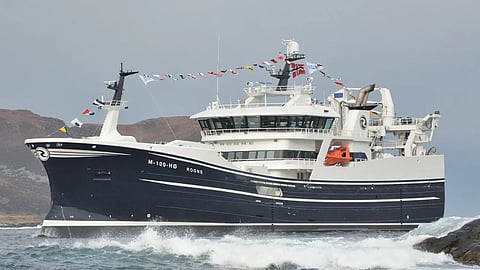
VESSEL REVIEW | Rogne – Versatile blue whiting trawler/seiner delivered to Norwegian fishing family
A new pelagic trawler that can also be used for purse seining has been handed over to Norwegian family-owned fishing company Rogne.
The DNV-classed newbuild is also the fourth vessel to bear the name Rogne. She was designed by Karstensens Skibsværft of Denmark, which was also responsible for her final outfitting, while construction of her hull took place at the Gdansk facilities of Karstensens Shipyard Poland.
As with other vessels in her owner’s fleet, Rogne will be used primarily to trawl for blue whiting west of Ireland, though it is also configured for catching herring and mackerel via purse seining.
Durable construction coupled with enhanced comfort

Rogne has an LOA of 83 metres (270 feet), a moulded beam of 16 metres (52 feet), a draught of 8.5 metres (28 feet), a depth of 11.35 metres (37.24 feet), a gross tonnage of 3,760, a crew of 14, and fuel oil and freshwater capacities of 570 cubic metres (130,000 gallons) and 38 cubic metres (8,400 gallons), respectively.
The design, interior design and arrangements have been created in close collaboration between the owner and the yard. The owner requested innovative solutions, and special emphasis has been placed on optimising working conditions, safety and comfort for the crew.
Hull design and optimisation were carried out with the goal of ensuring the lowest possible fuel consumption. The vessel also features heat recovery from all engines as well as a number of other measures to ensure low energy consumption.
The hull is built in steel with three continuous decks as well as reverse and boat decks with deckhouses. The boat deck, wheelhouse, and fore and aft masts are built in aluminium.
The hull is built on a round frame with an almost vertical bow with a bulb above and below the waterline. The stern is made of a knee line/bulb bow and skew.
Under the third deck, the hull is divided into watertight compartments consisting of a forepeak, a sonar room, tanks for freshwater and flushing water, an RSW cargo section with 13 tanks, a central pump/manifold compartment, and the engine room.
On the third deck are stores, an RSW cargo trunk section, and central compartments for the vacuum pump and the RSW cooling machinery. Aft of this are a machine shop, stores, three net tanks, and a hydraulic room that contains the steering gear. The interior of the third deck contains an exercise/wellness room, a laundry area, a machine control room, and a switchboard room as well as a hallway and stairs.
On the second deck are a starboard harbour generator room, two anti-roll tanks, 10 crew cabins with en suite toilets and showers, and an RSW control room. Aft of these are an enclosed cargo deck with hatches and loading tubes for the 13 RSW tanks. The screening box has been built into the hull.
By incorporating insulating panels and placing the interior spaces as far away as possible from the propeller and other sources of noise, the interiors are kept significantly quiet.
On the first deck there are anchor/mooring and purse seining winches, a fish pump, and fish hose and hydraulic hose reels. In front of the deckhouse are placed the aft gallows and seine tails. Also on the first deck level are a main crane and a fish pump crane.
The two deckhouses contain four officer’s cabins with en suite toilets and showers, a coffee bar, a changing room, an oil storage room, a shared toilet, a day room, a cinema, a mess, and a galley. The interiors were designed by Maritime Montering and NorSap provided the crew seats in the wheelhouse.
Full electronics suite suitable for extended trips
The wheelhouse itself features navigation and communication electronics from Furuno, Simrad, Sailor, MaxSea, Olex, Starlink, and Lars Thrane. A Teledyne FLIR gyrostabilised thermal camera is also fitted to permit safe navigation under low-visibility conditions.
Just outside the deckhouses are a Viking Norsafe MOB boat, which is to be launched into and recovered from the water via a dedicated davit.
Flexible propulsion setup for transits and fishing
The vessel is fitted with two Bergen 3,600kW (4,800hp) main engines, a Cummins 2,320kW shaft generator, and a propeller and gearbox arrangement from Brunvoll. Karstensens said this arrangement will provide sufficient power for propulsion during trawling, as well as for the side thrusters during seine fishing. When sailing normally, one main engine can already provide adequate propulsive power.
The propulsion can deliver a maximum speed of 18.9 knots. Should additional power be required, the vessel will rely on two Scania 600ekW auxiliary diesel generators.
The electrical system was built with the possibility of allowing parallel operation of the two Scania generators. The system is also equipped with a system for managing power consumption and for automatic start-up of the generators.
Kongsberg Maritime supplied the vessel’s steering system and rudder while Brunvoll provided the two side thrusters, one of which is an azimuthing thruster.
The array of winches was supplied by Karmøy while the hose reels are from SeaQuest Systems. Storm Cranes and Karmøy provided the selection of cranes while the trawl block is from Markussens.
