
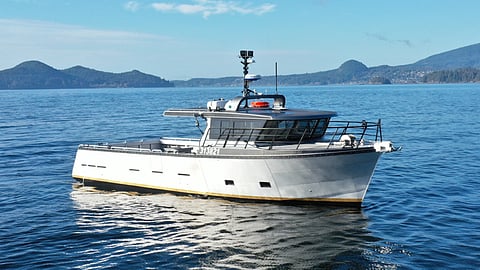
VESSEL REVIEW | Kaitiaki – Multi-purpose fishing boat to be deployed in British Columbia's coastal waters
Canada’s Tideline Boats recently handed over a new fishing vessel to local customer 46 South Fish Company.
The 13-metre (43-foot) long Kaitiaki was built by Tideline to a design by Australian naval architecture firm Southerly Designs. The construction was undertaken with Toura Boat Craft providing project management support.
“This vessel represents a modern North American interpretation of robust Southern Hemisphere aluminium fishing boats commonly used in Australian and New Zealand rock lobster fisheries,” Mark Urwin, Project Lead at Toura Boat Craft, told Baird Maritime.
“Many elements of the vessel were refined during construction based on operational experience by the owner. Particular emphasis was placed on sea handling, crew comfort (which reduces fatigue) while working and living aboard, manoeuvrability around gear, long range capability, efficient fish handling, and systems that support extended trips.”
“The brief from the owner was to bring the seaworthiness and construction techniques exemplified by Southerly Designs’ legacy of lobster fishing vessels across Australia and New Zealand into a locally built vessel on the west coast of Canada,” said Southerly Designs. “It also needed to comply with the local fisheries and marine safety regulations while delivering functionality across multiple fishing operations.”
“The brief was to deliver a versatile aluminum workboat capable of operating efficiently across multiple fisheries and in exposed coastal conditions, carry load at speed and also be a comfortable boat for crew and the owner’s family for recreational trips,” added Urwin. “Key requirements included generous flush deck space, holds for fish or live product, excellent low-speed control for working gear, long range capability, and systems laid out for straightforward access and maintenance.
The vessel also needed to support both short day trips and longer offshore operations and be easily switched over to different fishing methods.
The designer explained that there were a number of changes that needed to be made to its usual approach in order to comply with local regulations and to fit in with the regional building practices.
“Additionally, the length restrictions drove a large effort to fit more volume equipment and tankage into the hull than we would usually install in a lobster boat of similar length. So there was a significant amount of learning for us in understanding and complying with local regulations and building practices as regards equipment and arrangements to facilitate the maximum use of internal volume.”
Southerly Designs said the hull form ultimately was also influenced by these considerations and the necessary loads that would be applied by the enlarged RSW tanks and freezer spaces.
Adaptability to other fishing methods ensuring year-round use

The vessel was designed primarily to work in the British Columbia spot prawn fishery. However due to the relatively restricted spot prawn season and quota, the vessel needed to have the flexibility to operate in other fisheries. These include fishing in protected waters or offshore in cold weather or mild conditions; trap fishing for prawns in the spring; and line fishing for Albacore in the summer.
The platform is also suited to a wide range of other fisheries and operations including crab, salmon, longline fisheries, and commercial diving, making it a highly adaptable working vessel.
“This type of multifunctionality, whilst well-suited to the basic high-speed fishing vessel form that Southerly Designs has perfected over many years, nevertheless comes with its own unique challenges,” the designer remarked.
“The owner wanted to be able to move around gear more quickly and cover more ground in the prawn fishery,” Urwin told Baird Maritime. “It is a live fishery, and the boat has to meet a truck in the afternoon each day. The fishery operates on a derby format with a fixed window from 07:00 to 19:00, so there is no ability to start earlier. Speed, along with the ability to carry fully submerged live product, was something the previous vessel could not achieve.”
The holding capacity is large enough that the boat can stay out for several days until the tanks are full and there is a viable load for the truck. This allows a live prawn vessel to access a wider range of fishing grounds when the fishing slows down rather than being limited to areas close to port.
“The owner also wanted the flexibility to pursue other fisheries, such as fresh albacore tuna,” added Urwin. “In British Columbia, tuna are typically frozen at sea due to the distance offshore and away from unloading ports. For a fresh program to work, the vessel needs both speed and the ability to carry meaningful volume, which was a key consideration in the design brief.”
Propulsion allowing for greater control at all speed settings
The vessel is powered by one MAN D2868 V8 diesel engine producing 1,000 hp (750 kW) to drive a Veem propeller through a ZF gearbox fitted with smart controls. This setup provides both high performance and low-speed control.
“This propulsion arrangement provides quite a high power for a vessel of this length, reflective of the relatively high load carrying capacity required while still being able to achieve planning speeds,” said Southerly Designs.
The ZF smart command system allows the vessel to work gear at speeds as low as 1.8 knots, which is particularly valuable for prawn and longline operations.
An articulated rudder with a foil-shaped profile provides tight turning ability and responsive handling when operating around fishing gear or in confined spaces. Underwater exhaust and sound insulation in the engine room meanwhile provides a quiet vessel while working on deck, thus reducing crew fatigue.
“Steering is handled without a conventional wheel, instead using electric jog controls paired with a two-speed Kobalt steering manifold,” said Urwin. “This provides rapid HO to HO response of approximately 3.5 seconds on fast mode, or 10 second response for slow speed manoeuvring.
“For bonding the shaft to the hull, we went with an electro guard shaft ring which is supposed to give better protection. We also selected a set of Zipwake interceptors, which is great for fine tuning trim when carrying heavy loads on deck or in the holds. We opted for Veem’s interceptor strip on the prop to allow for fine tuning of the pitch without having to take the prop off.”
Electronics and deck equipment optimised for durability under extreme conditions
The navigation and control systems include a Furuno multi-function display (MFD), a Simrad autopilot, along with a dedicated PC running a TimeZero Pro plotter for fishing and navigation. The MFD is connected to a CHIRP transducer and amp, while the TimeZero system is coupled to a WASSP transducer.
“Lighting was an important consideration, particularly for running at night in British Columbia’s log ridden coastal waters,” added Urwin. “Durabrite lighting is used to illuminate the waterways ahead, improving visibility and confidence when navigating in the dark at speed. Additional onboard systems include Starlink internet, a Sonos sound system, and a Dometic hydronic heating system to support longer trips and year-round operation.”
Urwin said that the electronics suite reflects a focus on practical decision making and redundancy rather than feature overload. Systems were selected based on reliability and ease of use in working conditions.
The working deck is finished with a rubberized Endura coating, which provides good grip and added shock absorption during long hours of fishing.
“The deck layout is kept clean and clutter free, with excellent visibility from the raised wheelhouse,” Urwin told Baird Maritime. “The wheelhouse sightlines also work well from the outside working station when hauling traps, allowing the operator to maintain good awareness of both deck activity and the water alongside.”
The deck equipment includes a slack hauler mounted on the bulwarks for taking in slack when the buoy line is tight, and a main hauler positioned opposite the working station. Urwin said this arrangement keeps the long groundline pile away from the operator and crew when hauling prawn longlines and traps.
Both haulers are powered by an Eaton load sensing hydraulic pump driven off the main engine, which also supplies the bow thruster and deck wash down hose.
“The slack, or side, hauler is not commonly seen on fishing vessels in North America, but it is standard equipment on lobster boats in New Zealand,” said Urwin. “The owner wanted to incorporate one here so the crew would not be straining to bring a buoy line aboard when the tide is running or when the line has gone tight after slipping into deeper water.
“This ties back to the original brief around crew comfort and fatigue. The aim was to make the boat a safer and more comfortable workspace, particularly during long days on the water. These kinds of details are often overlooked on smaller fishing vessels, but they make a real difference in reducing physical strain and keeping crews working efficiently.”
Fish handling is supported by an RSW system producing chilled water across five tanks. Two of these tanks can be isolated and operated as freezers, allowing bait to be held on longer trips.
The accommodation includes two bunks forward and a double-berth space located beneath the wheelhouse. All accommodation spaces are fully insulated along with sound inundation and heating.
Comfortable interiors for family use
“Although the vessel is very much a working fishing boat, the quality of the wheelhouse and accommodation fitout was given a lot of attention,” said Urwin. “The intent was to move away from a utilitarian finish and create a space that is comfortable and practical for long days and extended trips. This approach supports crew well-being during fishing operations, while also allowing the vessel to be enjoyed recreationally, without detracting from its primary role as a commercial platform.”
The toilet and shower are on the deck and fitted on the port side, which produces shelter while hauling. This space also allows for drying of wet weather gear as there is a heater vent inside.
The vessel is also fitted with ultra-thin solar panels manufactured by Open Waters Solar. At under two mm thick, the panels can be walked on and still be able to provide over 20 amps of 24V power on clear days.
“The anchor and 24V electric drum winch are from Lone Star,” said Urwin. It has proved to be a great setup for the variance in anchoring depths in British Columbia. At the head of a fiord it can be shallow or 60 metres (200 feet) deep sometimes.”
As this was Southerly Designs’ first commercial vessel built in Canada, one of the initial challenges was becoming familiar with local regulations for commercial craft and identifying areas of potential risk.
”Working closely with Toura Boat Craft in Canada, it was determined early on that keeping the vessel under 15 GT, as calculated under local rules, would avoid many of the more onerous regulatory requirements and allow greater freedom in the overall design,” Urwin told Baird Maritime.
“To achieve this, the depth of the hull was kept to an absolute minimum while still accommodating the main engine. By carefully adjusting engine position and angle, it was possible to maximise overall length and beam while remaining under the 15GT threshold.”
Urwin said that with high installed power comes the need for a large propeller to effectively transmit that power to the water. Hull form was therefore critical, particularly aft, to ensure the keel line rose sufficiently to provide the required propeller tip clearance.
As the vessel was intended to operate across multiple fisheries, hull trim and loading conditions were carefully considered to ensure the boat floated and performed well across a wide range of operating scenarios.
“Working with an entirely new set of regulations and building practices requires at times a significant amount of ‘un-learning’ of established practice and re-imagining of several arrangements and features of the vessel,” added Southerly Designs.
Integrating a high power propulsion package, long range fuel capacity, RSW systems, fish holds, and accommodation into a compact hull that was restricted by licence requirements required careful coordination between builder, designer, and owner, as Urwin explained.
“Many decisions were finalised during construction to optimise access, weight distribution, and workflow on deck, which required close collaboration but ultimately resulted in a more functional vessel. It was like a game of Tetris; everything had a place and often was the only place it could go. There wasn’t much room to work with.”
The project nonetheless reinforced the value of having the owner/operator, designer, and builder aligned.
“The boat was fully designed and cut before the build started, with the fitout refined during construction,” added Urwin. “Involving the owner early and throughout allowed the fitout and system layouts to be tailored closely to how the boat would actually be operated. The owner’s operational experience informed practical decisions around access, workflow, and day to day use.
“From a build perspective, the project highlighted several areas we would approach more deliberately on future builds. One of the key learnings was the value of providing more detailed information at the fabrication stage. Adding clearer instructions directly onto cut parts, such as weld locations, weld types, and bracket placement, would help reduce assumptions on the shop floor and save time, labour, and cost, particularly when working with different yards.”
Urwin said Toura Boat Craft also learned the importance of involving the builder earlier in identifying potential labour efficiencies. Having such conversations upfront would help prevent costs from creeping during the fitout phase and lead to a smoother, more predictable build process overall
“All new design projects lead to an advancement of organisational knowledge and skill set,” said Southerly Designs. “The challenges of developing a design to suit the functional purpose whilst remaining within regulatory boundaries and practical limits of the vessel is a challenge familiar to all designers, and that is present every time we take on a new project.
“From this build we do walk away with significant knowledge of the boat building design and approval process in Canada, as well as some new approaches to the vessel arrangements.”
