
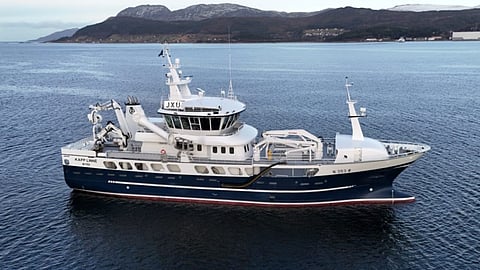
VESSEL REVIEW | Kapp Linne – Norwegian owner's new whitefish seiner boasts stun and bleed facilities
Norwegian fishing company Myre Kystdrift recently took delivery of a new whitefish seiner built locally by Larsnes Mek Verksted (LMV).
The Seacon-designed Kapp Linné was built from the outset to combine Danish seine fishing equipment for catching cod and salmon during winter with stun and bleed facilities for farmed salmon and trout, thus ensuring year-round operation.
Myre Kystdrift's owners Michael Lockert and Olav Lassesen had decided upon a combination vessel instead of having only one specialised yet costly platform that would only sit idle for eight months.
Dual processing lines for greater flexibility

The newbuild has a length of 51 metres (170 feet), a beam of 12 metres (39 feet), a draught of three metres (10 feet), and accommodation for 11 crewmembers.
Power is provided by a Yanmar 6EY26W 1,620kW (2,170hp) main engine that drives a Finnøy FD300 two-speed propeller via a Finnøy gearbox. The rest of the hybrid propulsion setup consists of a Scania DI13 91M generator and a battery pack supplied by Smart Automation.
The fish handling equipment includes five RSW tanks with a total capacity of 500 cubic metres (100,000 gallons) and two Optimar processing lines. One is a manual line with a conveyor belt for whitefish and the other is a fully automatic line for stun and bleed use.
The stun and bleed line consists of a swim-in unit, an electric stunner, a gill cutting robot, advanced camera technology, and a distribution system connected to the RSW tanks. According to Myre Kystdrift co-owner Michael Lockert, the bleeding line has a capacity of 80 tons of salmon per hour.
Optimar said considerable investment was made in hygiene measures on board. Therefore, the cleaning and sanitation processes are automated while the installed camera technology provides improved control and documentation throughout the entire production process. Specifically, camera technology will enable estimation of weight, size and species for each fish individually, resulting in more precise catch documentation for both salmon and whitefish.
LMV said the dual production line makes the vessel unique on a global scale, as it can transition seamlessly from traditional whitefish harvesting to bleeding operations for the aquaculture industry without extensive rebuilding or operational downtime. This also provides stable and predictable working conditions and ensures year‑round employment.
Comfortable accommodation ideal for extended-duration trips
The crew accommodation includes cabins, a mess, a galley, a conference room, a TV room, and a lounge. LMV said significant emphasis has been placed on crew comfort, with high‑quality furnishings and a refined, tonal interior design.
The interiors were laid out by Rovde Møbel and Design and feature Notronik fire suppression equipment. The lifeboats were supplied by Viking Life-Saving Equipment.
Kapp Linné has since replaced Kystfisk, a 31-metre vessel in the owner’s fleet. The plan is to operate the vessel on a four-weeks-on, four-weeks-off rotation, fishing whitefish from January 1 to April 1, before transitioning to assignments within the aquaculture industry for the remainder of each year. Once the whitefish season is over, the vessel will be thoroughly cleaned and prepared for aquaculture operations.
