VESSEL REVIEW | Freeberd – Alaska salmon fishing company to deploy new compact seiner in Prince William Sound
A new seine fishing vessel was recently delivered to Routli Meadow, a family-owned salmon fishing company that operates primarily in Alaska’s Prince William Sound.
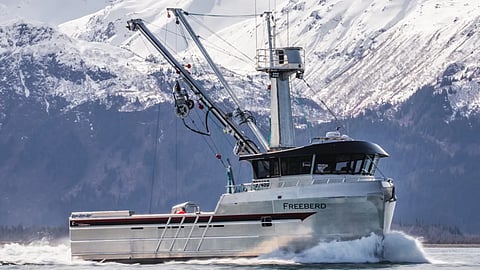
The all-aluminium Freeberd was built by Bay Weld Boats of Homer, Alaska, as a fully custom limit seiner built for nearshore fishing. Design work was undertaken in close collaboration with the Durtschi family, the owners of Routli Meadow.
Lightweight construction coupled with waterjet propulsion

The 58- by 24-foot (18- by 7.3-metre) purpose-built vessel boasts a draught of only four feet (1.2 metres) at full load, a depth of 8.8 feet (2.7 metres), a maximum displacement of 118 tons, waterjet propulsion for more precise manoeuvring, and a hold capacity of 140,000 pounds (64,000 kg).
The aluminium construction provides a balance between durability and low weight essential for shallow-water operations. One advantage of this is that the vessel can reach hatchery waters that the owner’s earlier wooden seiners were unable to access due to their deeper draughts.
Two John Deere 6135SFM85 diesel engines that each produce 750 hp (560 kW) drive two Hi Jet 600 waterjets via ZF 400 gearboxes to deliver a cruising speed of 10 knots and a top speed of 12 knots in calm conditions. A hydraulic bow thruster is also fitted to provide additional lateral manoeuvrability during low-speed transits in port.
Fuel is fed from a 1,600-gallon (6,100-litre) tank while two 250-gallon (950-litre) tanks will be used to store freshwater. The fuel capacity will ensure the extended endurance necessary for sustained operations in Prince William Sound.
Maximising space in a limited hull
The major components have been placed forward so that the hold can occupy as much space as possible without affecting the vessel’s stability or performance. Electronic joystick controls will meanwhile allow for single-handed docking and precise station keeping when deploying purse seine nets.
The aft deck has been laid out to facilitate rapid gear deployment and faster turnarounds. The deck equipment includes power blocks and hydraulic winches.
After the catch is brought on board, it is transferred directly to the RSW tanks for immediate processing and cooling. An MER 65kW generator supplies power for the RSW plant and the other major systems while the other onboard systems are connected to a smaller MER 12kW generator.
The wheelhouse electronics include video screens showing live camera feeds from the hold, the deck and the engine room and a Garmin through-hull transducer that can provide real-time images from depths of as much as 1,000 feet (300 metres). The wheelhouse itself boasts all-round visibility, an ergonomic layout, LED lighting, and dual helm stations with one facing amidships to ensure proper control during seining.
The onboard accommodation includes a captain’s cabin and a forward crew cabin with four berths. The other spaces include a galley and a dinette. A diesel furnace from Webasto keeps the interiors comfortable during long fishing trips.
For added safety, the vessel is fitted with non-skid grating, handrails, bilge pumps, and a CO2 fixed fire suppression system in the engine room.
