
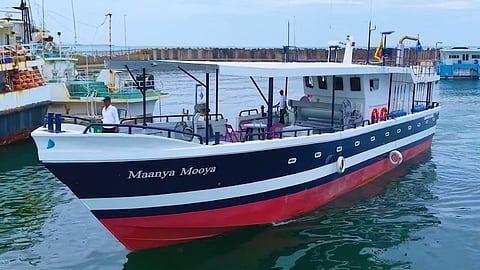
VESSEL REVIEW | Maanya Mooya – FRP longliner for Somali fishing exporter
Sri Lankan boatbuilder Dhanusha Marine Lanka Exports recently delivered Maanya Mooya, an FRP longline fishing vessel that the company has described as the largest FRP fishing boat ever built in the country.
The vessel was unveiled on March 3, 2025, at Dikowita Fishing Harbour near Colombo and has since entered service with Somali operator Marina Seafood, which is using it to export fish from Somalia to overseas markets.
The launch ceremony at Dikowita was attended by Sri Lanka's Minister of Fisheries, Aquatic and Ocean Resources Ramalingam Chandrasekar and Minister of Industry and Entrepreneurship Development Sunil Handunnetti. The Ministry of Fisheries described the event as the unveiling of the largest fishing vessel manufactured in Sri Lanka to date.
The boat was built for a Somali customer, and the industry ministry said at the launch that the project showed Sri Lankan manufacturers could compete for orders in international markets.
Capable of long-endurance fishing trips

Maanya Mooya has a length of 24 metres (79 feet), a beam of 5.59 metres (18.3 feet), and a draught of 2.1 metres (6.9 feet). The hull and superstructure are built of FRP, a material Dhanusha Marine has specialised in since it was founded in 2008 at the Fullerton Industrial Estate in Nagoda, Kalutara, south of Colombo. The company's in-house FRP work covers plug design and manufacture, mould making, glass-fibre casting, finishing and final assembly.
The vessel is configured for long-range commercial fishing, and the tankage reflects that role. Fuel capacity is 10,000 litres (2,200 gallons) and freshwater capacity is 8,000 litres (1,800 gallons). The insulated fish hold has a volume of 70 cubic metres (2.000 cubic feet). According to the builder, this gives the boat the storage needed for extended voyages without returning to port to discharge.
Propulsion is provided by a single Hyundai EN Tech HD 615 Series marine diesel engine rated at 441 kW (590 hp) at 2,000 rpm. Dhanusha Marine said the engine was selected for fuel economy over long distances rather than for outright speed.
Electrical power comes from a Weichai marine diesel generator set rated at 50 kW at 1,500 rpm and 50 Hz. The genset supplies the refrigeration plant, navigation electronics and communications equipment, which together represent the main hotel and process loads on a vessel of this type.
Ample catch storage and freezing facilities
Catch handling is a key feature of the design compared with a typical Sri Lankan multi-day boat. Refrigeration is split between a chilled room maintained at –5°C for fresh storage and a blast freezer set to –40°C, where fish can be frozen rapidly.
The arrangement allows the crew to freeze high-value fish quickly after landing while holding other product chilled for shorter periods, according to the builder's specification. The builder said the combination is intended to preserve catch quality across the length of a long trip.
Fishing gear comprises a hydraulic longline winch and a VHF radio buoy system for locating and recovering gear in deep water. The wheelhouse is fitted with an autopilot and a Koden radar, and the vessel carries a Starlink satellite internet terminal, giving the crew broadband connectivity at sea for weather data, communications with the owner and market information.
A CCTV system covers the working deck and other spaces for security and operational monitoring. Crew facilities include a galley, washrooms, and sleeping cabins.
Maanya Mooya is now operating from Mogadishu as part of the Marina Seafood fleet.
Mogadishu Port General Manager Ambassador Mohamed Ali Nur formally welcomed the company and the vessel in August 2026 as it began commercial fish export operations, saying the port would prioritise support for exporters as part of efforts to raise domestic production.
The vessel has entered a Somali fisheries sector that the country's government has identified as a priority for growth. A protocol signed by Somalia and China in July 2026 gave Somali fishery products duty-free access to the Chinese market, and Somalia has fisheries cooperation arrangements with Turkey and Egypt.
Somali officials have said that post-harvest losses in the domestic industry run at 30 to 40 per cent because of limited cold storage, which makes onboard blast freezing on a vessel such as Maanya Mooya directly relevant to an export operation.
