
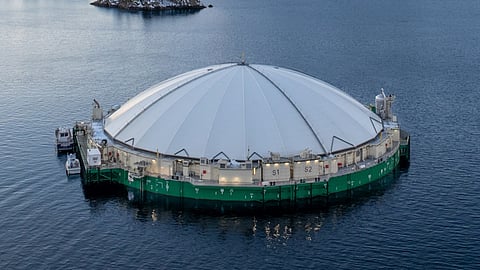
VESSEL REVIEW | Storbatsegga – Salmon pen capable of passive water circulation and remote operation
Norwegian salmon harvesting company Nordlaks has placed a new semi-closed fish pen into service.
Named Storbåtsegga, the structure was designed by Norwegian naval architecture firm NSK Ship Design and constructed by Turkish shipbuilder Gemak. The structure recently received its first stock of fish when a total of 68,464 fish with an average weight of 5.1 kg were delivered to the pen from the neighbouring locality of Brottøy.
Since the facility arrived in Vesterålen in November last year, work has been done to complete all the systems so that it would be ready to release fish. The structure was designed to have a rated production volume of 86,700 cubic metres (3.06 million cubic feet).
Built to permit continuous water circulation and to prevent infestation

Storbåtsegga was completed as a semi-closed production tank with a capacity of 3,120 tons of live Atlantic salmon or rainbow trout. The structure will utilise the naturally incoming current to exchange water in the tank, allowing for continuous circulation without active intervention by powered equipment.
The unit has a tight, dome-shaped roof and steel walls down to 20 metres (70 feet) below sea level as well as a minimum displacement of 6,000 tons, an outer diameter of 78 metres (260 feet), a height of 52 metres (170 feet), an operational draught of 30.6 metres (100 feet), and a maintenance draught of 11.5 metres (37.7 feet).
The tight construction will prevent lice and disease microbes, which mostly move in the top layer of the sea, from getting to the fish, while the hull wall acts as a physical barrier to reduce the impact on the fish from the surroundings.
The surface module that includes the roof also contains feed storage, a machinery room, and a workshop.
The structure has a guide vane module, which is a rigid construction consisting of a system of “wings” and shovels that follow the entire lower edge of the tank wall. The module will send water up and out to the sides of the production tank for powering and for water replacement inside the main tank.
Designed to minimise risk of fish escape and contamination of surrounding sea area
The structure has also been developed to prevent the escape of fish, as all materials in the construction have a completely different strength than those on most fish cages with open nets. A secondary barrier in the main net is fitted to further reduce the risk of fish escapes.
Through a manually controlled water exchange system, adapted to the strong ocean currents at the site, continuous access to fresh, oxygen-rich seawater is ensured. At the same time, the open bottom construction means that fish excrement is distributed naturally with the sea current.
Fitted out for fully or partially unmanned operations
The structure was developed to be permanently moored and capable of unmanned operation with human intervention needed only during receiving feed, transferring equipment or removing dead fish, though an onboard room is available for monitoring and control of production. Activities that are to be remotely controlled include opening of hatches for receiving feed and operation of surveillance cameras to monitor fish and feeding.
The pen also boasts an automatic feeding system; silos that can each hold up to 200 tons of pellets; a system for collecting, processing and storing dead fish; a water injection system as backup in the event of failure of the main passive circulation system; a shore power connection; and a diesel generator to provide backup power.
Other key features include a net handling system, an embarkation ladder, and two quays for arriving vessels. The net handling system was supplied by Evotec along with the capstans.
Tank capacities are approximately 165 cubic metres (36,300 gallons) for diesel and 75 cubic metres (16,000 gallons) for freshwater.
Maritime Montering was responsible for work on the accommodation as well as technical insulation throughout the structure.
Storbåtsegga was built in compliance with DNV class requirements.
