VESSEL REVIEW | Compact catamaran aquaculture workboats for cold weather use
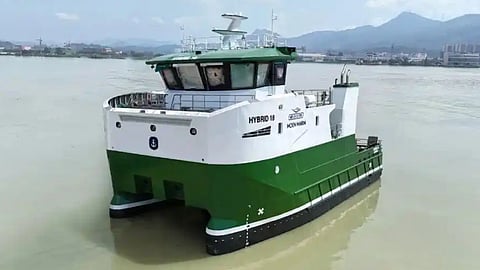
Chinese shipbuilder Jianglong Shipbuilding has delivered the first two vessels in a series of hybrid catamaran workboats designed for operation in cold weather.
Designed by Norwegian naval architecture firm Marin Design, the workboats are intended for service work at salmon farms. Jianglong said the type was, "specially developed for Norway's coastal and global high-latitude farming areas,” and ”supports full-scenario operations including aquaculture supply, cage maintenance, towing and anchoring."
The lead vessel in the series was launched on August 8, 2025.
Each vessel has an LOA of 20.95 metres (68.73 feet), a moulded beam of 12 metres (39 feet), and a depth of 5.1 metres (17 feet). The twin hulls are of steel, while the wheelhouse is of seawater-resistant aluminium. The builder credits this arrangement for the vessel's structural durability and seakeeping.
Propulsion arrangement adaptable to site transits and manoeuvring alongside pens
"The vessel incorporates specialised cold-resistant systems to ensure reliable performance in Norwegian and similar high-latitude frigid waters," the Municipal Government of Zhongshan, where Jianglong Shipbuilding is located, said at the time of the launch.
Propulsion is provided by two 575kW permanent magnet electric motors driving two propellers. Energy comes from a 1,260kWh lithium battery pack and three diesel generators. The workboats can run in either diesel electric hybrid or pure electric mode.
"It can operate in silent pure electric mode to avoid disturbing fish schools, while meeting IMO Tier III emission standards, balancing environmental protection and endurance," Jianglong Shipbuilding said.
Four electrically driven side thrusters and a dynamic positioning system allow each catamaran to hold station alongside cages and moorings. The maximum speed is 11 knots while the bollard pull is approximately 20 tonnes.
Full range of deck equipment that can be controlled remotely for greater safety

The aft working deck on each workboat measures approximately 150 square metres (1,600 square feet) and can carry a payload of about 80 tonnes.
The deck equipment includes two fully rotating HS.Marine hydraulic cranes, a working winch, towing pins, a stern roller, a shark jaw, and a mooring lock. Some of this equipment can be controlled via joystick from the wheelhouse.
The vessels also each carry deck cleaning and disinfection equipment and arrangements for access to fish farms. Ballast, firefighting, hydraulic, and automatic monitoring systems are integrated across the vessel.
The wheelhouse has reverse-angled windscreens to help reduce glare as seen from the helm station. The electronics include a radar, autopilot and echosounder from Furuno, an Olex chartplotter, and a Sailor VHF radio.
Each vessel has single-person cabins for eight crewmembers, along with a galley, air conditioning, floor heating, laundry facilities and low-noise compartments for extended deployments.
The design has been marketed as ideal for larger crews and more demanding operations, including work associated with submersible cages.
Construction of a third pair of 21-metre workboats began on July 1, 2025. On April 23, 2026, Jianglong signed an order for two additional 21-metre vessels valued at CNY92.8 million (US$13.9 million), with delivery scheduled for December 30, 2027. This took confirmed orders under the master contract to six vessels.