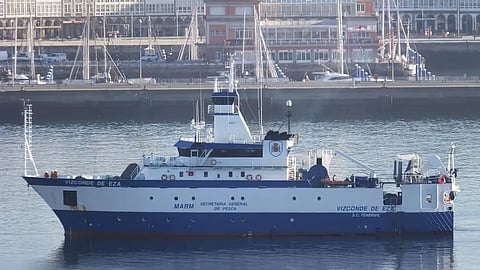

The Spanish Ministry of Agriculture, Fisheries and Food and the Spanish Institute of Oceanography are launching the Platuxa 2026 research campaign to study demersal fishery resources on the Great Bank of Newfoundland.
Operating in the Northwest Atlantic Fisheries Organisation regulatory area, the campaign aims to gather data on species of commercial interest to the Spanish fleet.
The ministry reported that its oceanographic research vessel Vizconde de Eza will depart from the port of Vigo on June 7 to begin the survey. The research initiative is scheduled to run from June 15 to July 4, before concluding in the Canadian port of St. John's on July 5.
Scientists will collect biological, growth, and reproduction data on populations such as American plaice, cod, Greenland halibut, redfish, lemon sole, grouper, grenadier, and northern shrimp.
The ministry stated this research is highly relevant for Northwest Atlantic bottom trawl fisheries, where redfish constitutes approximately nine per cent of the catch and Greenland halibut accounts for four per cent.
Data collected down to a maximum depth of 1,500 metres will also be used to analyse invertebrate communities and water parameters to assist the NAFO Scientific Council in assessing regional stocks.
The campaign has run continuously since 1995 under the Vigo Oceanographic Centre of the Spanish Institute of Oceanography and is co-funded by the European Maritime Fisheries and Aquaculture Fund.
The 53-metre-long Vizconde de Eza is equipped with six specialised laboratories and a specialised propulsion system designed to conduct silent navigation for acoustic data collection.

