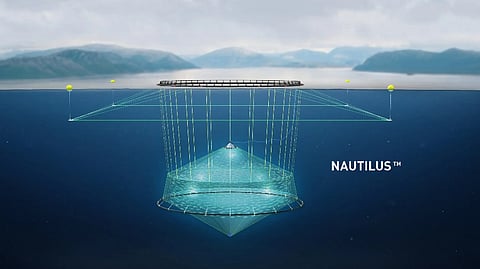

Submersible cod farming company Ode is increasing its investment in deep farming technology following the conclusion of its first production cycle. The company plans to roll out the solution to two additional sites during the spring of 2026.
The world’s first cod produced in a submersible cage was packed and sold to customers in Europe, the United States, and Asia shortly before December 25. Ode stated its production at the Alida site showed faster growth, improved control of maturation, and a more stable production environment.
"The positive results from Alida have confirmed most of our hypotheses about the benefits of deep farming for cod," said Chief Executive Officer Ola Kvalheim. He noted that the company must continue to develop in order to optimise and test the effects at a larger scale.
Deep farming involves keeping farmed cod deeper in the water column where temperature and light conditions are more stable. Ode noted this method provides improved biological conditions and greater predictability in production.
The company has invested in 10 new deep-farming units from AKVA Group. These units are expected by the company to be put into operation at the Vorpeneset and Svartekari sites.
"Deep farming at the right sites gives us a production environment that is more stable than what we have previously had access to," Kvalheim added. He believes this puts the company in a better position to manage efforts to scale up cod farming.
Chief Innovation Officer at AKVA Group Arnstein Hosaas mentioned that when the group started deep farming for salmon, the main motivation was to avoid lice infestation. He observed that the fish thrived due to less noise and fewer environmental changes at depth.

