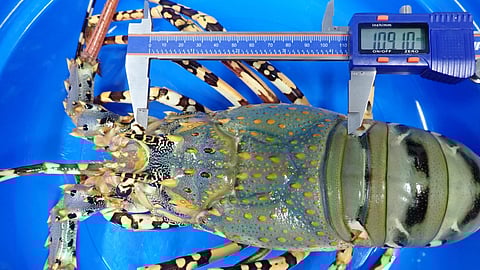

The Southeast Asian Fisheries Development Center (SEAFDEC) has begun work to develop sustainable farming techniques for spiny lobster (P. ornatus) and to evaluate its viability as a livelihood for coastal fishers in the Philippines.
The species has been recognised by SEAFDEC's Aquaculture Department (AQD) for its potential to strengthen a high-value industry due to its high market demand and abundant seed resources in the country.
“Although spiny lobster farming exists across the Philippine archipelago, it still depends on the collection of pueruli and juveniles from the wild, which are seeded into small-scale nursery and grow-out cages using traditional methods,” said SEAFDEC/AQD Chief Dan Baliao.
“We aim to standardise informal practices into science-backed production models with recommendations on optimal stocking density, appropriate feeding scheme, and environmental management.”
As part of this effort, Roselyn Baylon, a researcher at AQD, and her team identified a site in Guimaras province as a natural source of wild seeds of spiny lobsters. They conducted environmental monitoring to study the local ecology and verified catch data through interviews with fishers.
“These baseline data are essential for evaluating spiny lobster ecosystem dynamics and for guiding future fisheries management and stock assessment efforts,” said Dr Leobert de la Peña, head of the SEAFDEC/AQD Research Division.
At the Igang Marine Station of SEAFDEC/AQD in Guimaras, experiments are underway to determine the optimum stocking density and feeding practices in both nursery and grow-out phases of sea-based cage systems. Growth performance, survival and socioeconomic analyses are also being conducted.
“Through these experiments, the project has already established key growth benchmarks for spiny lobster, which are essential for achieving efficient production cycles,” Baylon said.
During the nursery phase, puerulus (larval) stage lobsters with an average body weight of 0.35 grams are reared for six months to reach approximately 50 grams, an ideal size for grow-out following strict husbandry procedures.
In the grow-out phase, lobsters reared for 12 months in sea-based systems attain body weights ranging from 500 grams to one kilogram, with carapace lengths between 7.9 cm and 10.9 cm, depending on stocking density.
“We conduct regular monitoring of water salinity, dissolved oxygen, pH, total suspended solids, nutrients, bacterial load, and sediment quality beneath cage facilities,” Baylon explained. “Temperature and light levels are also continuously logged.”
Lobster health assessments are also routinely performed to prevent or control diseases, enhance survival and health, and manage environmental impacts.
“Upon completion of this project, large-scale verification trials of the refined protocols will be done,” de la Peña added, while noting that controlling cannibalism and developing effective feed are also future research directions.
“Once standardised rearing protocols are developed and verified for spiny lobster, we will facilitate technology transfer through training and the establishment of sustainable livelihoods in coastal communities,” said Baliao.

